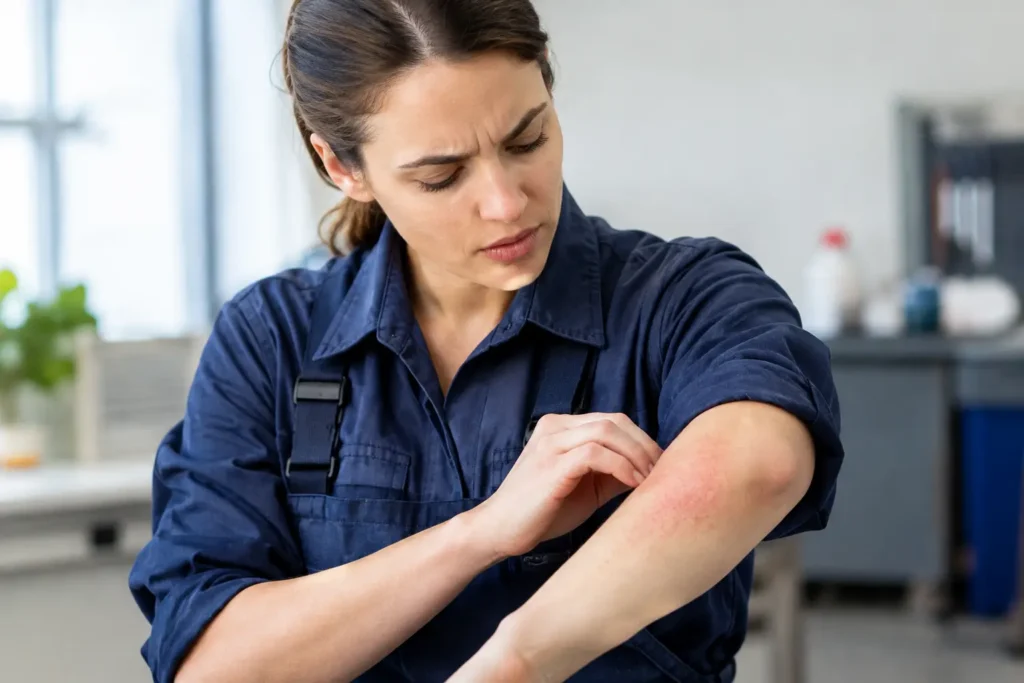

A workplace asthma example is rarely as simple as a worker saying, “I wheeze at work.” The clinical task is to establish whether work is causing asthma, aggravating existing asthma, or merely coinciding with symptoms triggered elsewhere. The answer can affect treatment, exposure control, fitness-for-work advice, statutory reporting and, critically, the worker’s long-term respiratory health.
For Occupational Health clinicians, the most useful approach is structured and timely. Ask the right exposure questions, arrange objective testing while the person is still exposed where safe to do so, and communicate recommendations that help the employer reduce risk without disclosing unnecessary clinical detail.
Consider a 34-year-old bakery assistant who reports cough, chest tightness and wheeze for four months. Symptoms are most troublesome towards the end of a shift and sometimes wake her at night after a busy day. She feels noticeably better over weekends and during a recent week of annual leave. Her GP has prescribed a reliever inhaler, which helps, but she has not yet had a confirmed asthma diagnosis.
Her work includes weighing flour, tipping bags into a mixer, dusting work surfaces and cleaning the mixing area. The bakery has general ventilation, but the flour bags are opened manually and there is visible dust when ingredients are transferred. She has no known previous asthma, although she has hay fever.
This pattern should immediately raise concern about occupational asthma, particularly sensitiser-induced asthma due to flour dust. The latency matters. A worker may become sensitised after weeks, months or years of exposure, then develop symptoms at very low airborne concentrations. Atopy increases the likelihood of sensitisation to some high-molecular-weight agents, such as flour, but it does not establish causation.
The initial OH opinion should not state that the worker definitely has occupational asthma. Instead, it should record a reasoned concern: symptoms are compatible with asthma; there is a plausible workplace sensitiser; and there is a work-related temporal pattern. That wording supports early action while diagnostic assessment continues.
A good occupational history turns a vague respiratory complaint into clinically useful evidence. Ask exactly what the person handles, how often, in what quantities and under what conditions. “Flour exposure” is not sufficiently detailed. The clinician needs to know whether flour is poured from height, whether mixers are enclosed, whether dust is cleaned with a brush or vacuum, and whether respiratory protective equipment is available, suitable and actually worn.
Clarify the timing of symptoms. Do they improve on days away from work? Are they worse late in the shift, in the evening or overnight? Have they improved during longer breaks? Symptoms can be delayed, which is why asking only whether the worker wheezes while standing beside an exposure source can miss occupational asthma.
It is also essential to establish functional impact. Can the worker complete a shift? Have they needed urgent care, oral corticosteroids or time away from work? Are they working alone, at height, driving, operating machinery or undertaking another safety-critical role where an acute attack could place them or others at risk?
A concise clinical assessment should cover smoking and vaping, allergic rhinitis, eczema, family history, previous asthma, current medicines and non-work triggers. Consider whether symptoms began after a single high-level irritant exposure, such as a spill or poorly controlled cleaning chemical. That scenario may suggest irritant-induced asthma rather than sensitiser-induced occupational asthma.
Occupational asthma is asthma caused by workplace exposure. Sensitiser-induced occupational asthma usually develops after a latency period. Common examples include flour, laboratory animal proteins, natural rubber latex, wood dust, isocyanates, welding fume and some cleaning agents.
Work-exacerbated asthma is different. The worker has pre-existing or concurrent asthma that becomes worse because of workplace conditions such as cold air, physical exertion, dust, fumes, stress or poor indoor air quality. It still deserves effective workplace intervention, but the implications for exposure investigation and prevention may differ.
The distinction is not academic. Where occupational asthma is suspected, ongoing exposure can lead to persistent disease and poorer prognosis. Early removal from the causative agent is often associated with better outcomes, although removal may bring significant employment and financial consequences. These trade-offs should be discussed honestly and managed with the worker, employer and respiratory specialists.
Occupational Health does not need to diagnose asthma in isolation. The clinician’s role is to identify the possibility promptly, arrange or recommend appropriate assessment, and reduce exposure while evidence is gathered.
Objective testing is central. Spirometry with bronchodilator reversibility, fractional exhaled nitric oxide where available, and assessment by a clinician experienced in occupational lung disease may be appropriate. Normal spirometry does not exclude asthma, particularly when the worker is assessed away from exposure or between episodes.
Serial peak expiratory flow monitoring is often especially valuable. The worker records readings at least four times daily over a period that includes workdays and days away from work, alongside work times, tasks, symptoms and inhaler use. The record must be completed carefully enough to show whether there is a consistent relationship between work exposure and variable airflow limitation. Poor-quality records can produce false reassurance or create avoidable uncertainty.
If a specific sensitiser is suspected, specialist testing may include immunological tests or other targeted investigations. These tests support, rather than replace, the occupational history and physiological evidence. Referral to a respiratory physician or specialist occupational lung disease service should be made early where occupational asthma is suspected.
There is a practical tension here. Continued exposure can assist diagnosis, but deliberately exposing a symptomatic worker to a suspected sensitiser is not an acceptable workplace strategy. In a worker with significant symptoms, escalating reliever use, abnormal lung function or a recent severe attack, protection takes priority. Temporary redeployment away from the suspected agent may be the safest course while urgent specialist advice is obtained.
Telling the bakery assistant to wear a disposable mask is not a sufficient control plan. Respiratory protective equipment is the last line of defence and may be poorly fitted, inconsistently used or unsuitable for the level and type of dust exposure.
A stronger OH recommendation focuses first on eliminating or reducing exposure at source. In this case, the employer could review whether flour handling can be enclosed, whether ingredients can be supplied in lower-dust formats, and whether local exhaust ventilation is effective at the point of transfer. Cleaning methods matter: dry sweeping redistributes dust, whereas suitable vacuum systems or wet-cleaning methods reduce airborne contamination.
Temporary redeployment may mean moving the worker to packing, front-of-house duties or another area without flour handling. The suitability of this arrangement depends on symptoms, confirmed diagnosis, workplace layout and the likelihood of indirect exposure. A role described as “flour-free” is not necessarily safe if dust migrates from the mixing area through shared ventilation or clothing.
Where respiratory protective equipment is necessary for residual risk, it requires a proper programme: suitable selection, face-fit testing for tight-fitting masks, user training, maintenance, storage and consideration of facial hair. It should complement engineering controls, not substitute for them.
With the worker’s informed consent, the report should address functional restrictions and risk controls, not reveal a detailed medical history. For this case, an appropriate opinion might state that the worker has respiratory symptoms potentially related to flour dust exposure and requires temporary avoidance of flour handling and dusty cleaning tasks pending urgent medical investigation.
The report can recommend a review of flour-dust controls, assessment of local exhaust ventilation, and consideration of whether other workers have respiratory symptoms. It should specify a review date and identify triggers for earlier reassessment, such as worsening symptoms, urgent treatment or failure of redeployment to control symptoms.
Employers should also consider their duties under the Control of Substances Hazardous to Health Regulations. Where occupational asthma is diagnosed and is attributable to work, reporting duties may arise under RIDDOR. The organisation should seek appropriate competent advice rather than assuming that an individual OH report alone completes its legal obligations.
The first mistake is treating the absence of wheeze during an OH appointment as reassurance. Asthma is variable, and the consultation may occur on a non-working day or after the worker has used a reliever inhaler.
The second is accepting “better at weekends” as proof. It is a useful clue, but symptoms may also improve because sleep, infection, smoking, home exposures or prescribed treatment have changed. Objective data and exposure assessment are needed.
The third is relying on a job title rather than the actual task. A cleaner may be exposed to sprays, disinfectants or powders; a vehicle repair worker may encounter isocyanates; a healthcare worker may handle latex or cleaning products. Exposure is found in the detail.
Finally, do not frame redeployment as a failure. In suspected occupational asthma, prompt adjustment can protect lung function while preserving work participation. A well-designed temporary arrangement also gives the employer time to correct the exposure problem for the wider workforce.
For learners, this is where a structured workplace asthma example becomes more than an examination scenario. It is a clinical reasoning exercise with real consequences: recognise the pattern early, gather objective evidence, protect the worker from avoidable harm and give clear advice that can be acted on. Each careful assessment can improve not only one person’s prognosis, but also the safety of everyone doing the same job.