A worker brings you a monitoring report showing solvent vapour levels below the stated limit. The immediate temptation is to reassure them. But an occupational exposure limits guide should do more than help you compare two numbers. It should help you ask whether the sample represents the job, whether controls are genuinely effective, and whether the worker’s symptoms or vulnerability change the clinical picture.
For Occupational Health clinicians, nurses and technicians, exposure limits sit at the meeting point of science, risk assessment and practical workplace advice. Knowing the terminology matters. Applying it well is what makes your recommendation credible and defensible.
In Great Britain, Workplace Exposure Limits (WELs) are published in EH40. They set legal limits for airborne concentrations of specified hazardous substances in workplace air. Employers must control exposure under the Control of Substances Hazardous to Health Regulations 2002 (COSHH), and must not allow exposure to exceed the relevant WEL.
A WEL is not a bright line between harmless and harmful. It is an exposure-control benchmark based on the available evidence, feasibility and regulatory judgement. Individual susceptibility varies. A worker with asthma may experience work-related symptoms at concentrations that are well below a WEL for a respiratory irritant or sensitiser. Equally, a compliant personal sample cannot prove that every shift, task or worker is protected.
This distinction is central to Occupational Health practice. A limit helps inform risk; it does not replace clinical assessment, a good occupational history, or an examination of the work process.
Most WELs are expressed as a time-weighted average (TWA) over eight hours. This reflects average exposure across a standard working day. A worker may have varying exposure during a shift, provided the overall eight-hour average remains at or below the limit.
Some substances also have a short-term exposure limit (STEL), usually measured over 15 minutes. These limits address short peaks that may cause acute effects such as eye irritation, respiratory irritation, dizziness or central nervous system effects. A low eight-hour average does not compensate for repeated high peaks.
A useful mental model is simple: the TWA asks, “What was the worker exposed to over the day?” The STEL asks, “Were there harmful peaks during the task?” Both may matter during decanting, cleaning, spraying, maintenance, spill response or entry into enclosed spaces.
Before interpreting a percentage of a WEL, establish what was measured and how. Was it personal sampling in the breathing zone, or static area sampling? Personal sampling usually provides the more relevant indication of an individual’s inhalation exposure. Static monitoring can help identify sources and trends, but it may underestimate exposure during mobile or variable work.
Then consider whether the worker sampled was doing a representative task on a representative day. A sample taken during routine production may miss the weekly tank clean, the poorly controlled maintenance activity or a period when local exhaust ventilation was switched off. For a mixed role, the assessor needs to understand the duration and frequency of each task, not merely the job title.
Units also require care. Airborne contaminants may be reported in milligrams per cubic metre (mg/m³) or parts per million (ppm). Conversion is substance-specific and depends on molecular weight, so values should not be converted casually. Check the stated WEL, the sampling method, the duration and the laboratory report before drawing conclusions.
Where shifts regularly exceed eight hours, the interpretation needs additional thought. The published eight-hour TWA is based on a conventional working day and recovery period. Extended shifts may reduce recovery time and increase cumulative exposure. There is no universal adjustment that can be applied mechanically. Review the pattern of work, the substance’s toxicology, peak exposures, rest periods and the quality of controls, escalating for specialist occupational hygiene advice where needed.
A result below a WEL can be reassuring, but only if it fits the wider evidence. Symptoms, incident reports, absenteeism patterns and surveillance findings may reveal an issue that a single monitoring exercise has not captured.
This is particularly relevant for sensitisers. For occupational asthma, the aim should be to prevent sensitisation and minimise exposure as far as reasonably practicable, not simply to remain below a numerical limit. Ask about work-related nasal, eye, chest and skin symptoms, including improvement away from work. Early recognition and timely exposure reduction can have major implications for prognosis.
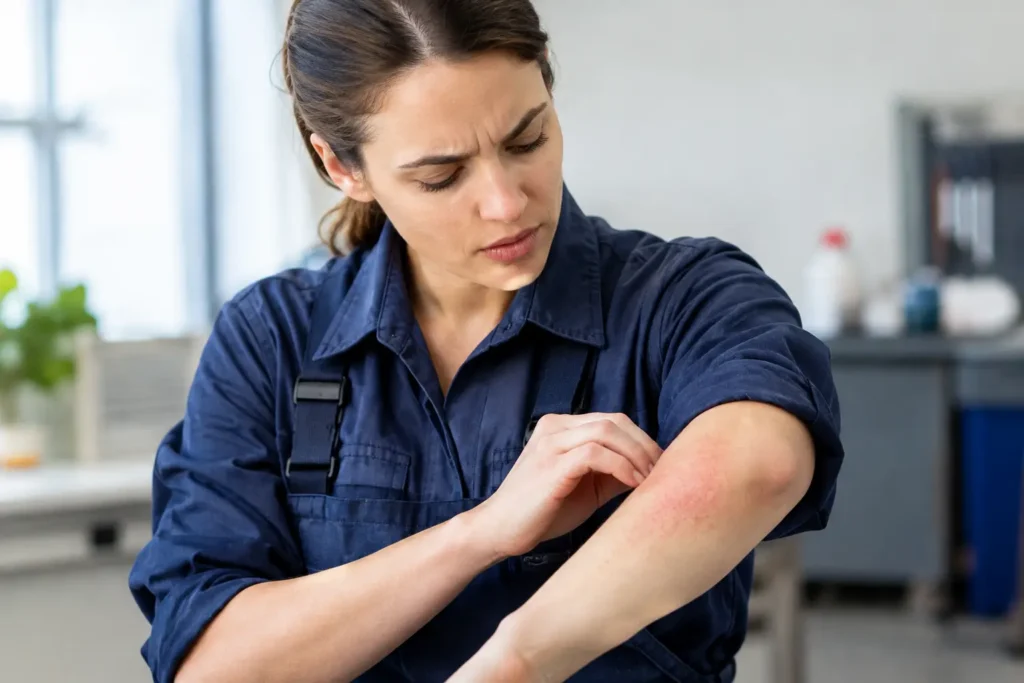
The same principle applies to dermal exposure. WELs address airborne concentration, not skin contact. A worker may have an acceptable inhalation measurement while still developing occupational dermatitis from wet work, contaminated surfaces, splashes or unsuitable gloves. Your assessment should follow the route of exposure rather than allowing the air-monitoring result to dominate the case.
For carcinogens, mutagens and some other high-hazard agents, legal compliance is only the starting point. The control objective is to reduce exposure to as low a level as is reasonably practicable. In practical terms, this means asking whether the process can be eliminated, enclosed or automated, rather than treating a result just under the limit as a finished job.
Occupational Health professionals are not expected to perform every exposure assessment. However, they should be able to recognise weak controls and contribute to proportionate recommendations. The hierarchy of control gives structure to that conversation.
Elimination or substitution is preferable where a hazardous substance can be removed or replaced with a safer alternative. Engineering controls come next: enclosure, process isolation and effective local exhaust ventilation can reduce exposure for everyone, without relying on individual behaviour. Administrative measures, such as limiting time on a task, cleaning procedures and training, may support these controls but are rarely enough on their own. Respiratory protective equipment (RPE) is valuable when correctly selected, face-fit tested, maintained and worn, but it should not be the default answer to poor process control.
A clinically useful recommendation is specific. Rather than writing “improve PPE”, identify the concern: for example, review whether the extraction hood captures vapour at the point of decanting; confirm that workers required to wear tight-fitting RPE have current face-fit testing; or assess whether glove selection is suitable for the chemical and duration of contact.
Exposure monitoring and health surveillance answer different questions. Monitoring asks how much hazardous agent is reaching the worker’s environment. Health surveillance looks for early adverse effects in workers who remain at risk despite controls.
Health surveillance may be appropriate where there is a recognised disease, valid techniques can detect early signs, and action can improve outcomes. Examples include respiratory surveillance for workers exposed to respiratory sensitisers, skin surveillance for relevant dermatitis risks, and audiometry for noise-exposed workers. It should not be used as a substitute for controlling the hazard.
When reviewing an individual, take a task-based history. Ask what substances they use, how they are applied, when symptoms occur, whether there are high-exposure events and whether colleagues are affected. Explore controls in reality, not only on paper. A worker may report that RPE is uncomfortable, that gloves tear, or that production pressure makes use of extraction impractical. These details often explain why a technically adequate risk assessment has failed in practice.
Where symptoms suggest a possible occupational disease, act promptly. Advise appropriate temporary exposure reduction or avoidance while assessment is underway, document the reasoning clearly, and communicate functional recommendations without disclosing unnecessary clinical detail to management. Fitness for work decisions should be individualised. The correct outcome may range from continued work with improved controls to temporary redeployment, depending on the hazard, symptoms, diagnosis and available adjustments.
When faced with an exposure report or a clinical concern, work through four questions. First, what is the hazardous agent and which route of exposure is relevant? Second, does the monitoring represent the highest-risk task and the worker’s actual exposure? Third, are the controls effective in normal use, including during abnormal events? Finally, is there clinical or surveillance evidence that requires action regardless of the numerical result?
This approach prevents two common errors: treating a WEL as a guarantee of safety, and treating any detectable exposure as proof that someone is unfit for work. Good Occupational Health advice is proportionate, evidence-based and grounded in the realities of the job.
As your experience grows, do not view exposure limits as figures to memorise for an examination or report. Use them as prompts for sharper questions about work, controls and health. That is where a monitoring result becomes a safer, more confident workplace decision.