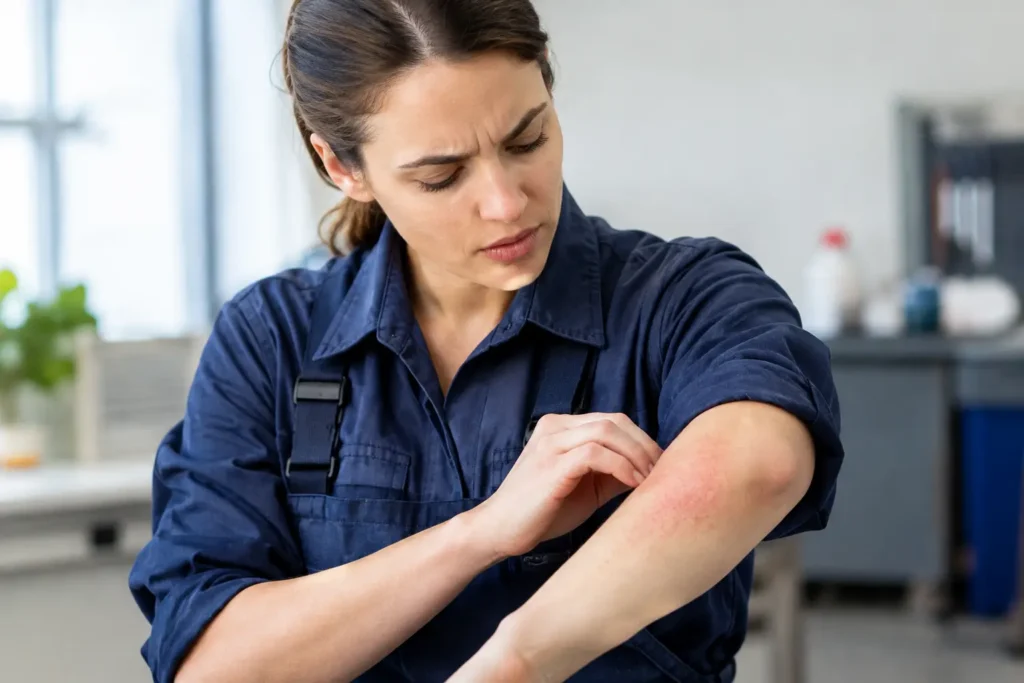
A worker is issued a tight-fitting respirator, passes a face-fit test and returns to a task involving welding fume, flour dust or silica. The missing question is whether they can safely tolerate the physiological and psychological demands of wearing it. Respirator medical clearance addresses that question, but it is not a simple administrative sign-off and it is not the same as face-fit testing.
For Occupational Health professionals, the value lies in making a proportionate, defensible assessment that protects the worker without creating unnecessary barriers to work. The decision must reflect the respiratory protective equipment (RPE), the task, the exposure risk, the worker’s health and the controls already available.
“Respirator medical clearance” is a widely used term, particularly in international guidance. In UK practice, it is more useful to think in terms of medical fitness to wear RPE. The employer’s wider duties arise under COSHH and related health and safety law: exposure must be prevented or adequately controlled, and any RPE selected must be suitable for the wearer and the work.
There is no one-size-fits-all UK certificate that makes somebody medically fit for every respirator, in every environment. A disposable filtering facepiece used briefly for low-demand work creates a different burden from a full-face, tight-fitting reusable respirator used during sustained physical work in heat. Powered air-purifying respirators may reduce breathing resistance, but introduce their own practical considerations, including battery management, compatibility and protection level.
The Occupational Health assessment should therefore answer a focused question: can this individual wear this specified type of RPE, for this task and working pattern, without an unacceptable risk to themselves or others?
These two processes are often wrongly treated as interchangeable. They address separate parts of the risk assessment.
Face-fit testing assesses whether a particular tight-fitting mask can achieve an adequate seal on that wearer. It does not establish whether the worker can tolerate increased breathing resistance, heat, communication limitations, visual restriction or the anxiety some people experience in enclosed facepieces.
Medical fitness assessment considers the person’s capacity to use RPE safely. It may identify a need for adjustments, further clinical information, a different respirator type or review of the job design. Neither process replaces the need to control exposure at source. Local exhaust ventilation, process enclosure, substitution and safer methods of work remain higher on the hierarchy of control than PPE.
A worker can be medically fit yet fail a face-fit test because of facial characteristics or incorrect mask selection. Equally, a worker may achieve a good face seal but require medical review because of unstable respiratory disease or symptoms brought on by respirator use.
The depth of assessment should be proportionate. For some roles, an employer-led health questionnaire, supported by clear referral criteria and Occupational Health oversight, may be appropriate. For higher-risk work, complex health histories or symptoms, an individual clinical assessment is more appropriate.
Referral is particularly sensible where the worker reports breathlessness, chest pain, fainting, significant palpitations, poorly controlled asthma or COPD, or previous difficulty wearing a mask. Claustrophobia, panic symptoms, facial skin disease and conditions affecting communication or cognition can also be relevant. So can pregnancy, although pregnancy alone does not automatically mean that RPE is unsuitable. The task demands, heat stress, duration of use and the individual’s symptoms matter.
Consider the role rather than the diagnosis alone. A person with well-controlled asthma who uses an appropriate respirator comfortably may be fit for the stated work. Another person with the same diagnosis, frequent exacerbations and exertional breathlessness may need treatment optimisation, temporary restrictions or a review of controls. Fitness is functional and contextual.
A good assessment begins with the exposure and the equipment, not with a generic medical form. Establish what contaminant is present, the expected concentration, whether oxygen deficiency is possible, the RPE type, the required wear time and whether the task is physically demanding or performed in hot conditions.
Then explore the worker’s relevant health history, current symptoms, medication, exercise tolerance and prior experience of RPE. Ask directly about breathlessness on exertion, wheeze, cough, chest symptoms, dizziness, heat intolerance, panic and skin problems. Where indicated, clinical examination, spirometry or information from the treating clinician may help. These investigations should answer a specific clinical question rather than being ordered routinely as a substitute for judgement.
The assessment should also identify safety-critical implications. If a worker needs to remove RPE urgently because of distress, can they do so safely? Could impaired vision, hearing or communication compromise rescue arrangements, vehicle operation or team safety? In confined spaces or emergency response work, the threshold for detailed assessment and clear escalation is understandably higher.
A consistent framework helps clinicians make decisions that are both person-centred and auditable. Four elements are especially useful:
The outcome should be specific. “Medically cleared” is often too vague to guide management. “Fit to wear the specified half-mask respirator for routine tasks, with review if exertional breathlessness develops” is more useful. If a powered respirator is proposed as an alternative, state that final selection must still meet the exposure-control requirements and be assessed by competent health and safety personnel.
Not every concern requires exclusion from work. Temporary adjustment may be the safest and most practical option while a condition is stabilised. For example, a worker recovering from an acute chest infection may be unsuitable for strenuous RPE use for a short period but able to return following symptom resolution and review.
Facial hair creates a different issue. A tight-fitting respirator requires an effective seal, and facial hair in the sealing area will usually prevent this. This is principally a face-fit and equipment-selection issue, not medical clearance. A powered hood may be an option in some settings, but only if it provides the necessary protection and does not introduce unacceptable task-specific limitations.
Skin conditions may require review of mask material, wear duration, skin-care advice or, where suitable, alternative RPE. Claustrophobia may respond to gradual familiarisation and supervised practice, but severe panic symptoms should not be dismissed as a training problem. The correct approach depends on whether the worker can safely complete the task and whether another control measure is reasonably practicable.
A defensible Occupational Health record shows how the decision was reached. Record the stated job demands, relevant history and symptoms, information reviewed, clinical reasoning, advice given and the date or trigger for review. If the assessment relied on incomplete information about the RPE or task, make that limitation explicit.
Employers need a clear functional outcome: fit, fit with specified adjustments, temporarily restricted, or not fit for the described RPE-dependent work. They do not need diagnostic labels, detailed medical history or medication lists unless the worker has given informed consent and there is a clear occupational reason.
Review is not an afterthought. It may be needed after a significant change in health, a new respirator, increased work intensity, an incident involving RPE, reported intolerance or a material change in exposure. Routine review intervals should be guided by the nature of the role and organisational policy rather than copied uncritically from another setting.
Respirator assessments reward structured clinical reasoning. The strongest decisions connect the hierarchy of control, RPE selection, face-fit requirements, functional health assessment and confidentiality. They also recognise uncertainty: where key information is missing, the safest recommendation may be temporary restriction while the task and controls are clarified.
For learners developing Occupational Health practice, case-based thinking is particularly valuable. Start with the real question the employer needs answered, separate medical fitness from face fit, then translate the clinical outcome into practical workplace advice. That approach makes respirator medical clearance more than a form to complete – it becomes a focused fitness-for-work decision that supports safe, sustainable work.