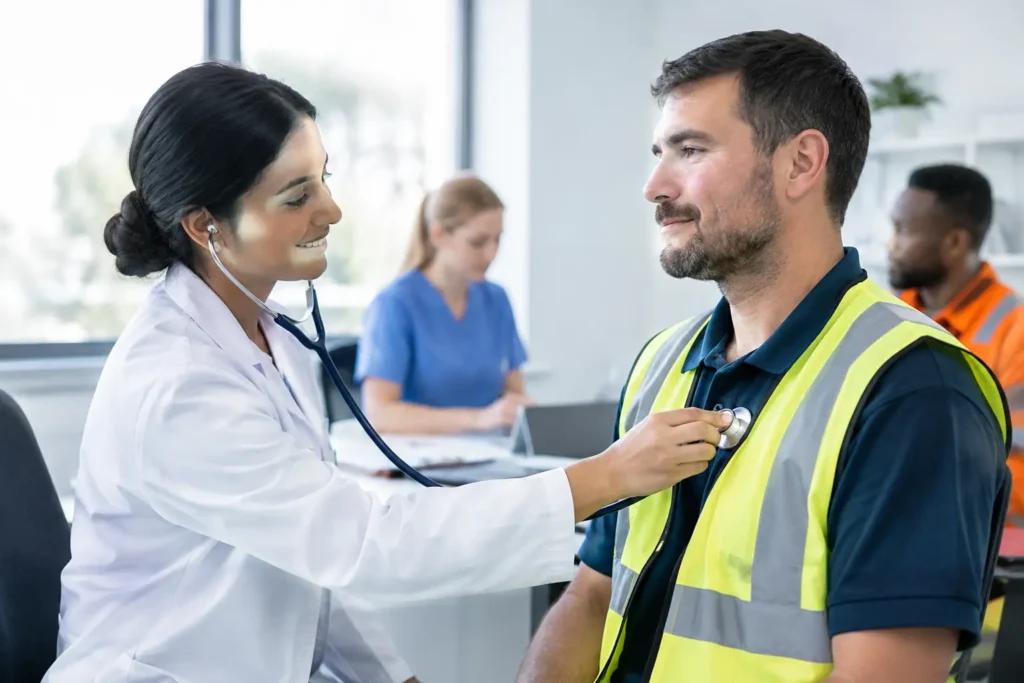
A borderline spirometry result, an employee worried about skin irritation, or a noise-exposed worker with a new hearing concern can quickly become more than a routine appointment. A strong health surveillance training course helps Occupational Health professionals recognise what the result means, what to do next, and how to communicate a defensible recommendation without overstepping the evidence.
Health surveillance is often mistaken for a sequence of tests carried out at set intervals. In practice, it is a clinical and workplace process. It sits at the point where exposure risk, individual health, functional ability, confidentiality and employer responsibility meet. That is why training must develop more than familiarity with questionnaires, audiometry or lung function testing. It must build sound judgement.
The starting point is purpose. Health surveillance is appropriate where there is an identifiable work-related disease or adverse health effect, a reasonable likelihood that it may occur in the particular work setting, and a valid technique for detecting early signs. Crucially, early detection should lead to action that benefits the worker.
This distinguishes surveillance from general wellbeing checks or broad health promotion. Blood pressure, weight and lifestyle advice may be valuable in a workplace health programme, but they are not automatically health surveillance. A good course makes these boundaries clear, because unclear purpose creates inconsistent practice, misplaced reassurance and records that are difficult to defend.
Training should also explain that surveillance never replaces prevention. If a group of employees are developing dermatitis, abnormal lung function or hearing changes, the central question is not simply whether the next assessment is due. It is whether exposure controls are adequate. Occupational Health can identify patterns and advise on individual fitness, but the employer must address the hazard through the hierarchy of control.
Effective surveillance begins before the worker enters the clinic. Practitioners need to understand the job, the substance or agent involved, the route and level of exposure, existing controls, and the likely health effect. This applies whether the concern is flour dust, isocyanates, wet work, vibration, noise, lead or respiratory sensitisation.
A training course should teach learners how to read a risk assessment critically rather than accept it as a static document. Ask whether the exposure profile reflects the work actually being done. Has the employee changed tasks? Are controls used consistently? Are there short periods of intense exposure that are being missed? These questions turn surveillance from an administrative task into useful workplace intelligence.
A result is rarely a decision in itself. Audiometry may identify a threshold shift, but the practitioner must consider baseline information, test quality, symptoms, hearing protection use and the worker’s exposure history. A respiratory questionnaire may raise concern, but it needs to be followed by focused clinical assessment and, where indicated, appropriate referral.
This is where clinically grounded learning matters. Learners should practise interpreting normal, borderline and abnormal findings through realistic cases. They need to know when a repeat test is appropriate, when temporary removal from exposure may be sensible, and when urgent escalation is required. A protocol is helpful, but it cannot replace clinical reasoning.
Health surveillance produces two different types of information. The worker’s clinical record is confidential. The employer, however, needs clear occupational advice: whether the individual is fit for the relevant work, whether restrictions or adjustments are needed, and whether workplace controls require review.
This balance is particularly important when employees worry that a result could affect their role. Training should therefore cover informed consent, proportionate information sharing, data handling and the wording of outcome reports. The aim is to give the employer enough information to act while respecting the employee’s privacy and autonomy.
A well-written recommendation is specific. Rather than stating that someone is simply “unfit”, explain the relevant limitation and what may reduce risk. For example, temporary avoidance of a sensitising agent pending specialist assessment, review of respiratory protective equipment, or redeployment away from high-noise tasks while concerns are investigated. The exact advice depends on the evidence, the job demands and the available controls.
The strongest learning pathways combine technical competence with workplace context. A practitioner may be confident using equipment yet still feel uncertain about the next step when findings do not fit neatly into a protocol. Case-based learning closes that gap.
For Occupational Health technicians, this may mean becoming confident in standardised testing, equipment checks, accurate record keeping, recognising red flags and escalating appropriately. For nurses and doctors, the emphasis may extend to clinical interpretation, fitness-for-work advice, referrals, report writing and advising organisations on emerging patterns. Both groups need clarity about their scope of practice and access to appropriate clinical governance.
Visual teaching is especially useful for topics that are easier to understand when seen rather than memorised. Diagrams can show the mechanism of occupational asthma, the effects of noise exposure or the pathway from exposure to disease detection. Interactive scenarios then ask the more valuable question: what would you do with this information in a real consultation?
Assessment also has a place. Short knowledge checks, SBA-style questions and mock scenarios reveal whether learners can apply principles under pressure. They are not only for examination preparation. They help expose common errors, such as treating surveillance as diagnostic confirmation, giving overly broad fitness advice, or failing to recognise when a cluster of cases needs wider workplace action.
The right health surveillance training course depends on your current role and the decisions you are expected to make. A short CPD module can be suitable when you need to refresh knowledge in one surveillance area or understand a new workplace exposure. A more structured course is usually the better choice for professionals moving into Occupational Health, technicians developing competency, or clinicians who need confidence across several programmes.
Look for teaching that is aligned with UK Occupational Health practice and addresses the practical realities of working with employers and employees. It should cover legal and ethical principles, but should not stop there. Learners need repeated opportunities to work through consultation findings, risk information, report wording and escalation decisions.
Flexibility matters as well. Many practitioners are fitting development around clinics, case management and family commitments. Fully online learning is useful when it allows study in manageable sections, revisiting complex material and returning to resources when a real case prompts a question. Lifetime access can be particularly valuable because health surveillance competence develops through repeated use, not a single period of revision.
At Zosh Occupational Health Academy, physician-led online learning uses visual lessons, applied cases and assessment practice to make specialist Occupational Medicine concepts more manageable and directly relevant to workplace decisions.
After completing training, the most useful next step is to review one existing surveillance pathway in your service. Trace it from risk assessment to invitation, assessment, clinical review, employer feedback and follow-up. Where does information become unclear? Where are escalation responsibilities uncertain? Are outcomes recorded consistently enough to identify a pattern over time?
Small improvements can have a meaningful effect. A clearer questionnaire, a more structured abnormal-result pathway or more precise report wording can improve worker experience and support earlier intervention. Equally, knowing when to pause and seek senior clinical input protects both the worker and the practitioner.
Health surveillance is at its best when it gives people a safer route to remain in work, while helping organisations see where prevention needs strengthening. Build your knowledge around that purpose, and each test result becomes the beginning of a better workplace decision rather than the end of a form.