Recognise Hazards
Identify hazardous agents, workplace processes, exposure sources, affected workers, and high-risk activities.
Understand, Assess, Measure and Control Workplace Health Risks
Develop the practical knowledge required to recognise workplace hazards, interpret exposure information, evaluate occupational risks, and recommend effective control measures.
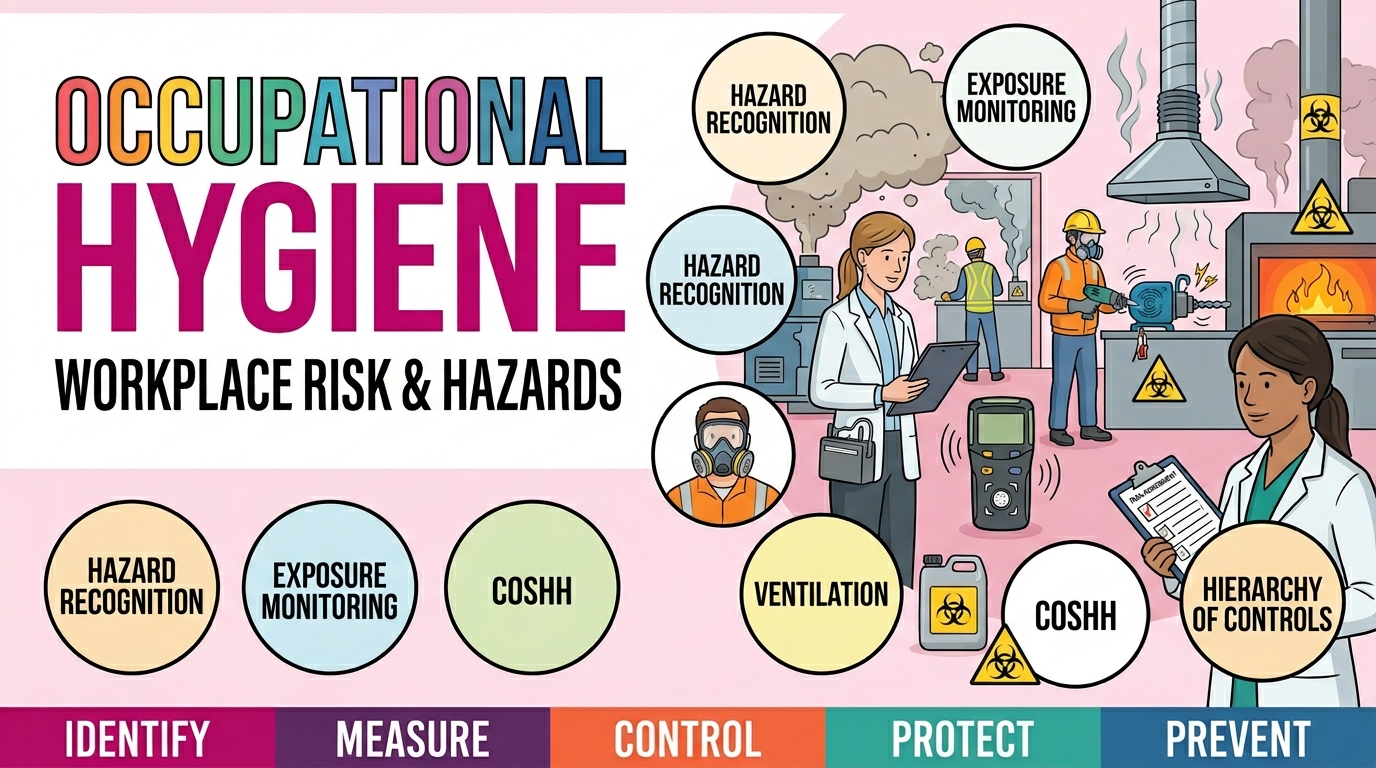 Course 05
Watch the course introduction to learn how occupational hygiene principles can support workplace risk assessment, exposure control, health surveillance, and worker protection.
Occupational Health professionals are frequently required to assess health risks arising from workplace hazards, interpret exposure information, advise on control measures, and understand the principles that underpin occupational hygiene practice.
A sound understanding of occupational hygiene is essential for effective risk assessment, health surveillance, fitness-for-work decision making, and workplace health protection.
This comprehensive 30 CPD hour course provides a practical and clinically relevant introduction to occupational hygiene principles and their application within Occupational Health practice.
Designed for Occupational Health physicians, nurses, hygienists, and MFOM candidates, the course explains how workplace hazards are identified, evaluated, measured, and controlled to prevent work-related illness and injury.
Across 15 structured sections and 44 detailed video tutorials, learners will explore the complete occupational hygiene process.
Identify hazardous agents, workplace processes, exposure sources, affected workers, and high-risk activities.
Assess exposure routes, duration, frequency, intensity, health effects, and the likelihood of worker harm.
Use appropriate sampling and monitoring methods to measure contaminants and workplace exposure levels.
Compare findings with workplace exposure limits, occupational standards, and relevant legal requirements.
Apply the hierarchy of controls and recommend effective, proportionate, and sustainable control measures.
Solvents, gases, vapours, metals, fumes, dusts, fibres, liquids, and other hazardous substances.
Noise, vibration, radiation, heat, cold, pressure, lighting, and other environmental workplace factors.
Bacteria, viruses, fungi, allergens, biological materials, and infectious workplace exposures.
Manual handling, repetitive tasks, posture, force, workplace design, and musculoskeletal strain.
Workload, workplace relationships, organisational culture, job demands, control, and work-related stress.
Understand how multiple hazards, work processes, and individual factors may interact to increase health risk.
Learners will develop an understanding of workplace risk assessment methodologies, risk categorisation, risk matrices, exposure pathways, and the practical evaluation of workplace health risks.
Detailed coverage is provided on COSHH principles, workplace exposure limits, occupational exposure standards, and the legal framework governing workplace health protection.
Particular emphasis is placed on the hierarchy of controls and selecting measures that eliminate or reduce exposure before relying on personal protective equipment.
Remove the hazard or hazardous process completely.
Replace the hazard with a safer material or process.
Isolate or control exposure at its source.
Use procedures, training, supervision, and work planning.
Use suitable PPE where residual exposure remains.
A major component of the course focuses on occupational exposure assessment and the interpretation of monitoring results.
Understand the purpose, application, and limitations of workplace exposure limits and occupational standards.
Interpret average exposure levels measured over a defined working period.
Understand limits used to control brief periods of higher exposure and acute health effects.
Consider sampling duration, equipment, worker activity, process variability, and result reliability.
Read occupational hygiene reports and identify findings that are clinically and operationally important.
Apply exposure information to health surveillance, risk communication, and Occupational Health recommendations.
Ventilation systems form an important part of the programme. Learners will gain a practical understanding of general ventilation and local exhaust ventilation systems.
The course explains ventilation design principles, performance testing, smoke testing, airflow measurements, capture velocities, maintenance requirements, and common causes of ventilation control failure.
Learners will also explore how ineffective system design, poor positioning, inadequate maintenance, process changes, and worker practices can reduce the effectiveness of exposure controls.
Selection, suitability, filter type, fit testing, maintenance, limitations, and appropriate workplace use.
Understand material compatibility, breakthrough, coverage, contamination, and safe removal procedures.
Select appropriate gloves based on chemical, biological, mechanical, and task-related hazards.
Choose suitable protection for splashes, particles, radiation, impact, and hazardous workplace processes.
Complex occupational hygiene concepts are explained in a practical and clinically relevant manner, enabling Occupational Health practitioners to better understand workplace exposure reports and contribute to workplace risk management.
Learners will develop the confidence to communicate effectively with occupational hygienists, safety professionals, managers, employees, and other members of the workplace health team.
The course supports evidence-based advice relating to health surveillance, exposure reduction, worker education, medical assessment, workplace adjustments, and the prevention of occupational disease.
More than 300 single best answer multiple choice questions are included to test theoretical knowledge and the practical application of occupational hygiene principles.
Recognise chemical, physical, biological, ergonomic, and psychosocial workplace hazards.
Understand risk assessment methods, COSHH principles, exposure standards, and the hierarchy of controls.
Interpret occupational exposure measurements, sampling results, and hygiene reports.
Understand ventilation systems, respiratory protection, chemical protective clothing, and biological monitoring.
Provide practical and evidence-based Occupational Health advice that supports healthier and safer workplaces.
Learn with an academic author and experienced Occupational Health Physician practising in the United Kingdom.
Get full access to 44 video tutorials, 15 structured sections, more than 300 examination questions, and 30 CPD hours for £220.