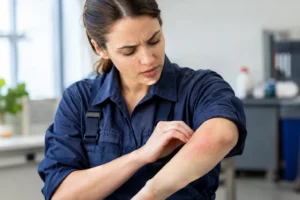

A nurse presents to Occupational Health with cracked, painful hands that have become steadily worse over four months. She assumes it is simply “dry skin”, but this occupational dermatitis example shows why a focused exposure history matters. The clinical task is not only to identify a likely diagnosis. It is to decide whether work is causing, aggravating or merely coinciding with the condition, then recommend proportionate controls that allow safe work where possible.
For Occupational Health clinicians, dermatitis assessments sit at the intersection of clinical reasoning, workplace risk assessment and fitness-for-work advice. A clear, defensible approach can prevent a manageable early condition becoming chronic hand eczema with significant effects on work, sleep and quality of life.
The employee is a 34-year-old ward nurse with no current medical problems. She has a history of childhood eczema, which resolved in her teens. Since joining a busy acute ward, she estimates washing or sanitising her hands more than 30 times in a shift. She wears disposable gloves frequently, sometimes for extended tasks, and reports that her hands can feel hot and sweaty afterwards.
Initially, she noticed dry skin over the backs of both hands. This progressed to erythema, scaling and painful fissures around the knuckles and finger webs. Symptoms improve during a fortnight’s annual leave but recur within several shifts of returning to work. She has tried over-the-counter moisturiser intermittently but continues to use fragranced hand wash at home.
On examination, there is bilateral erythema, dryness, scaling and superficial fissuring on the dorsal hands and fingers. The palms are less affected. There are no vesicles, no sharply demarcated lesions and no signs of bacterial infection. Her symptoms are itchy at times, but pain from fissuring is now the greater problem.
This pattern is most consistent with irritant contact dermatitis, probably caused by cumulative wet work, detergents, alcohol hand rub and occlusive glove use. Her past atopic eczema is relevant because it may indicate a more vulnerable skin barrier. It does not, however, prove that the workplace is unrelated. Predisposition and occupational exposure can both be clinically important.
The label “hand dermatitis” is not enough for an Occupational Health assessment. The history should connect symptoms to specific work activities, products and timing. Ask what the worker handles, how often, for how long and with what skin protection. Clarify handwashing frequency, use of alcohol gel, glove material, glove duration and whether hands are fully dried before gloves are worn.
A useful question is: “Talk me through a typical shift from the moment you arrive.” It often reveals exposures the worker does not initially identify as relevant. In this case, the nurse also cleans small items of equipment with disinfectant wipes, uses detergent wipes between patients and occasionally assists with spill management. She cannot identify one single exposure that triggers immediate symptoms. That makes cumulative irritancy more likely, although it does not exclude allergy.
The temporal pattern is equally valuable. Improvement away from work supports an occupational contribution, but it is not definitive. Domestic wet work, childcare, hobbies, cold weather and personal skincare products may all sustain dermatitis. Conversely, a condition that fails to improve at weekends may still be work-aggravated when the skin barrier has been substantially damaged.
Ask specifically about previous eczema, asthma, hay fever, psoriasis and known skin allergies. Establish what products are used at home and whether the worker has recently changed soap, cosmetics, gloves or cleaning agents. Also ask whether colleagues have similar symptoms. A cluster may point towards a product or process problem requiring workplace action, not simply individual clinical management.
Irritant contact dermatitis is common in wet-work occupations, including healthcare, catering, cleaning, hairdressing and food production. It usually develops gradually after repeated exposure to water, soaps, detergents, disinfectants, friction or occlusion. Hands often become dry, sore, red and fissured before itch becomes prominent.
Allergic contact dermatitis results from sensitisation to a specific substance. Possible workplace allergens include rubber accelerators in some gloves, preservatives, fragrances, resins, metals and chemicals in cleaning or manufacturing processes. Symptoms may extend beyond the precise contact area, and itch can be marked, but appearances overlap considerably. A late onset after a period of apparently tolerated exposure should increase suspicion, though it is not diagnostic.
There are other possibilities. Protein contact dermatitis may occur in food handlers exposed to fish, flour or animal proteins and may combine immediate itch or urticaria with chronic eczema. Psoriasis, fungal infection, scabies and infection of fissured skin should be considered where the presentation is atypical. A unilateral rash, nail changes or well-defined plaques deserve particular scrutiny.
Occupational Health does not need to provide every dermatological answer at the first consultation. It does need to recognise uncertainty, arrange appropriate clinical review and avoid declaring a worker “allergic” without evidence. Patch testing, usually through dermatology or a specialist contact dermatitis service, may be appropriate where allergic contact dermatitis is suspected or disease persists despite sensible exposure reduction.
For the nurse in this case, immediate exclusion from all patient-facing duties may be unnecessary. That decision depends on the severity of lesions, infection control requirements, ability to practise effective hand hygiene and the availability of temporary adjustments. The priority is reducing avoidable skin damage without compromising patient safety.
Advice should be specific enough to act on. The worker should use the designated mild hand cleanser when hands are visibly soiled, rather than repeated washing where alcohol-based hand rub is clinically appropriate. Hands should be dried carefully, including between the fingers. An unperfumed emollient should be used regularly before, during and after shifts, provided local infection prevention policy permits it.
Glove practice deserves attention. Gloves are not a treatment for dermatitis and wearing them continuously can worsen occlusion and sweating. The worker should select the appropriate glove for the task, use the shortest practical wear time and change gloves between tasks in line with infection control procedures. If glove allergy is suspected, the employer should review glove composition with procurement and seek specialist advice before substituting products.
Temporary adjustment might include reducing non-essential cleaning tasks, avoiding known irritating products, providing access to suitable skin-care products and allowing brief breaks for emollient application. Where hands are severely fissured, painful or infected, short-term redeployment away from wet work may be justified. Recommendations should describe functional limits and controls, rather than simply stating that the employee is “unfit”.
A moisturiser handed to one worker is not a complete occupational intervention. The employer should review the risk assessment for wet work and skin exposure. This may involve checking that suitable washing facilities are available, confirming that products are necessary and appropriately selected, ensuring gloves fit and are used correctly, and providing education on hand care.
Health surveillance may be indicated where employees are exposed to substances or processes associated with occupational dermatitis and there is a reasonable likelihood of disease. In practice, this commonly includes pre-placement baseline information, periodic skin questionnaires or checks, and a clear route for prompt referral when symptoms arise. Surveillance is not a substitute for exposure control. Its value is early detection, before employees normalise symptoms and continue damaging exposure.
Document the clinical findings, reported exposures, likely work relationship, advice given and agreed follow-up. Consent, confidentiality and the distinction between clinical information and an employer report remain essential. An employer usually needs functional advice and recommended controls, not a detailed dermatology history.
Arrange review after a defined period, often four to six weeks depending on severity. At follow-up, assess whether symptoms have improved, whether adjustments were actually implemented and whether there are new clues suggesting allergy or an alternative diagnosis. Photographs taken with consent can help monitor change, particularly when lesions fluctuate.
If the nurse improves after reduced wet work, consistent emollient use and better glove practice, the working diagnosis of irritant occupational dermatitis is strengthened. If there is little improvement despite good controls, reconsider the diagnosis, adherence, domestic exposures and need for dermatology referral. A persistent rash should not be managed indefinitely through repeated informal advice.
For learners preparing for Occupational Medicine assessments, the key lesson is that a high-quality dermatitis opinion is structured rather than speculative. Define the clinical problem, map the exposure, consider competing diagnoses, recommend workable controls and review the outcome. That is how an apparently routine skin complaint becomes a clear workplace health decision.
The most helpful question to leave with the worker is often simple: “What would make your next shift less damaging to your hands?” Their answer can reveal the practical control that turns a written recommendation into genuine recovery.