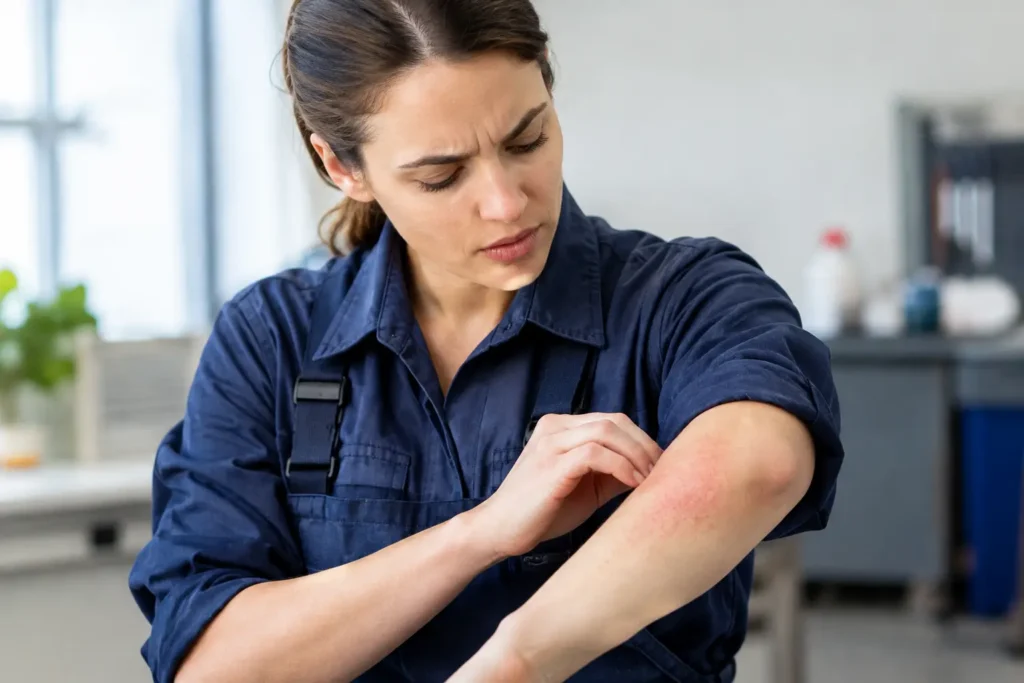

A worker who says, “I get a rash from gloves”, may have irritant dermatitis, allergic contact dermatitis, or an immediate latex allergy with a risk far beyond dry hands. Knowing how to assess latex allergy properly prevents both unnecessary work restrictions and potentially serious exposure. In Occupational Health, the task is not simply to label an allergy. It is to establish the likely mechanism, assess the level of workplace risk, and translate the clinical picture into proportionate controls and clear fitness-for-work advice.
“Latex allergy” is often used loosely. A structured history is the most valuable first step because the timing, symptoms and exposure pattern usually point towards the correct diagnosis.
Natural rubber latex can cause three distinct clinical problems. Irritant contact dermatitis is common and is not an allergy. It is usually caused by wet work, frequent handwashing, occlusion, friction, sweating or glove powder. The hands may become dry, sore, fissured or erythematous, often after repeated use over time.
Type IV delayed hypersensitivity is allergic contact dermatitis, usually caused by chemical accelerators used in the manufacture of rubber gloves rather than latex proteins themselves. Symptoms typically develop hours to days after exposure and can include itching, eczema, vesicles and spreading dermatitis.
Type I immediate hypersensitivity is the potentially serious condition most people mean by latex allergy. It is an IgE-mediated reaction to natural rubber latex proteins. Symptoms can begin within minutes of exposure and may include urticaria, itching, rhinitis, conjunctivitis, wheeze, chest tightness, angioedema or anaphylaxis. This distinction matters because a worker with immediate symptoms requires urgent exposure control while diagnostic assessment is arranged.
Ask the worker to describe the first symptoms, how quickly they appeared, where they occurred, how long they lasted and whether they reliably improve away from work. A precise timeline is often more useful than a broad statement that gloves “cause a reaction”.
The history should connect symptoms to particular tasks, products and routes of exposure. In healthcare, this may include examination gloves, surgical gloves, dental products, tourniquets, catheter equipment or resuscitation equipment. In other settings, consider rubber gloves, elasticated materials, adhesives, seals, rubber components and balloons.
Clarify whether gloves are natural rubber latex, nitrile, vinyl, neoprene or another material. Workers may reasonably assume all gloves contain latex, while the actual problem may be a glove accelerator, hand sanitiser, frequent cleansing or prolonged occlusion. Obtain product information or involve the employer’s procurement team where uncertainty remains.
Relevant questions include whether symptoms occur only with glove use, whether they occur with airborne exposure to powdered latex gloves, and whether the worker reacts during dental treatment, surgery or other healthcare contact. Although powdered latex gloves have been widely removed from UK healthcare settings, historical exposure and residual risks in some workplaces still matter.
Ask specifically about systemic features. Wheeze, throat tightness, dizziness, collapse or generalised urticaria following latex exposure should be treated as red flags. Establish whether emergency treatment was needed, whether adrenaline has been prescribed, and whether the worker has a current allergy specialist plan.
Atopy, eczema and asthma do not diagnose latex allergy, but they may increase susceptibility to skin problems and complicate interpretation. A history of reactions to certain foods can also be relevant. Banana, avocado, kiwi and chestnut are associated with latex-fruit syndrome, although food sensitivity alone does not confirm occupational latex allergy.
Examination should include the hands, wrists and any other exposed areas. Look for dryness, fissuring, erythema, scaling, vesicles and the distribution of dermatitis. Hand eczema can impair glove tolerance, increase discomfort and affect infection prevention practice, even where no allergy is present.
Do not allow the absence of visible dermatitis to falsely reassure you. Immediate latex reactions may leave no lasting skin signs between episodes. Equally, dermatitis alone should not be assumed to be Type I allergy.
If the history suggests an immediate reaction, act on the risk before confirmation. The worker should avoid natural rubber latex exposure, and the employer should identify suitable alternatives. Where there has been respiratory compromise, angioedema or suspected anaphylaxis, urgent specialist assessment is indicated. It is not appropriate to conduct an informal workplace “test” by asking the worker to wear latex gloves again.
This is a practical principle for defensible Occupational Health practice: remove or reduce a credible hazard while the diagnosis is being clarified. Clinical uncertainty is not a reason to continue a potentially high-risk exposure.
Testing should support, not replace, a credible exposure history. For suspected Type I natural rubber latex allergy, referral to an allergy service or clinician experienced in occupational allergy assessment is usually appropriate. Investigation may include latex-specific IgE blood testing and skin-prick testing, interpreted alongside the history.
A positive IgE result indicates sensitisation, not necessarily clinically relevant allergy. A negative result may also need careful interpretation if the history is strongly suggestive or testing has been performed long after exposure ceased. This is why Occupational Health reports should avoid overconfident conclusions based on a single laboratory result.
For delayed allergic contact dermatitis, patch testing is the relevant investigation. Testing should include the rubber additives and accelerators found in the worker’s actual gloves where possible. A referral to dermatology or a specialist contact dermatitis service may be needed, particularly for persistent, severe or diagnostically unclear hand eczema.
Challenge testing has a limited role and should only be considered in an appropriately supervised specialist setting when it is necessary to resolve uncertainty. It is not an Occupational Health clinic procedure or a workplace experiment.
Fitness-for-work decisions should be based on the diagnosis, the worker’s symptoms, their role and the availability of effective controls. A confirmed Type I latex allergy does not automatically mean the person cannot work in healthcare or another latex-containing environment. It does mean that natural rubber latex exposure must be reliably controlled.
For many roles, a latex-free glove policy for the individual, supported by suitable non-latex equipment, will allow full duties to continue. Nitrile gloves are often a practical option, but not every nitrile product is accelerator-free. If patch testing identifies an accelerator allergy, procurement must check the chemical composition of alternatives rather than simply switching materials.
A well-designed plan may include substitution of gloves and equipment, clear labelling of latex-containing items, communication with managers and colleagues on a need-to-know basis, and review of emergency arrangements. For workers with a history of severe immediate reactions, the plan should consider accidental exposure, access to urgent treatment, and whether particular areas or procedures carry a residual risk that cannot be adequately controlled.
Occupational Health should avoid vague advice such as “avoid latex where possible”. Specify what must be avoided, what alternatives are acceptable, which tasks can continue, and who is responsible for obtaining compliant products. This reduces the chance that a worker is handed a different brand of glove that creates the same problem.
Where symptoms are suspected to be work-related, document the onset in relation to employment, exposure frequency, product details, symptom timing, relevant test results and the controls agreed. This supports clinical continuity and helps the employer investigate whether others may be at risk.
Consider whether formal reporting or employer health surveillance arrangements are required within the organisation’s wider occupational risk management process. The precise action will depend on the diagnosis, severity, workplace exposure and local governance. A single employee with hand dermatitis may highlight a broader problem with glove selection, hand-care provision or wet-work controls.
Review is particularly valuable after changes have been made. Ask whether symptoms have settled, whether the replacement product is genuinely available on every shift, and whether the worker can carry out their normal duties safely. A plan that works on paper but fails during a busy clinical list is not an effective control.
A careful latex assessment brings clinical reasoning and workplace reality together. When you identify the mechanism, verify the exposure and set out specific controls, you give the worker something more useful than a label: a safe, workable route to remain in employment with confidence.