The Scientific Method
Understand observation, research questions, hypothesis development, data collection, analysis, interpretation, and conclusion.

Understand Research, Interpret Evidence and Apply Statistics Confidently
Develop the practical skills required to critically appraise research, interpret epidemiological data, understand statistical findings, and apply scientific evidence to Occupational Health decisions.
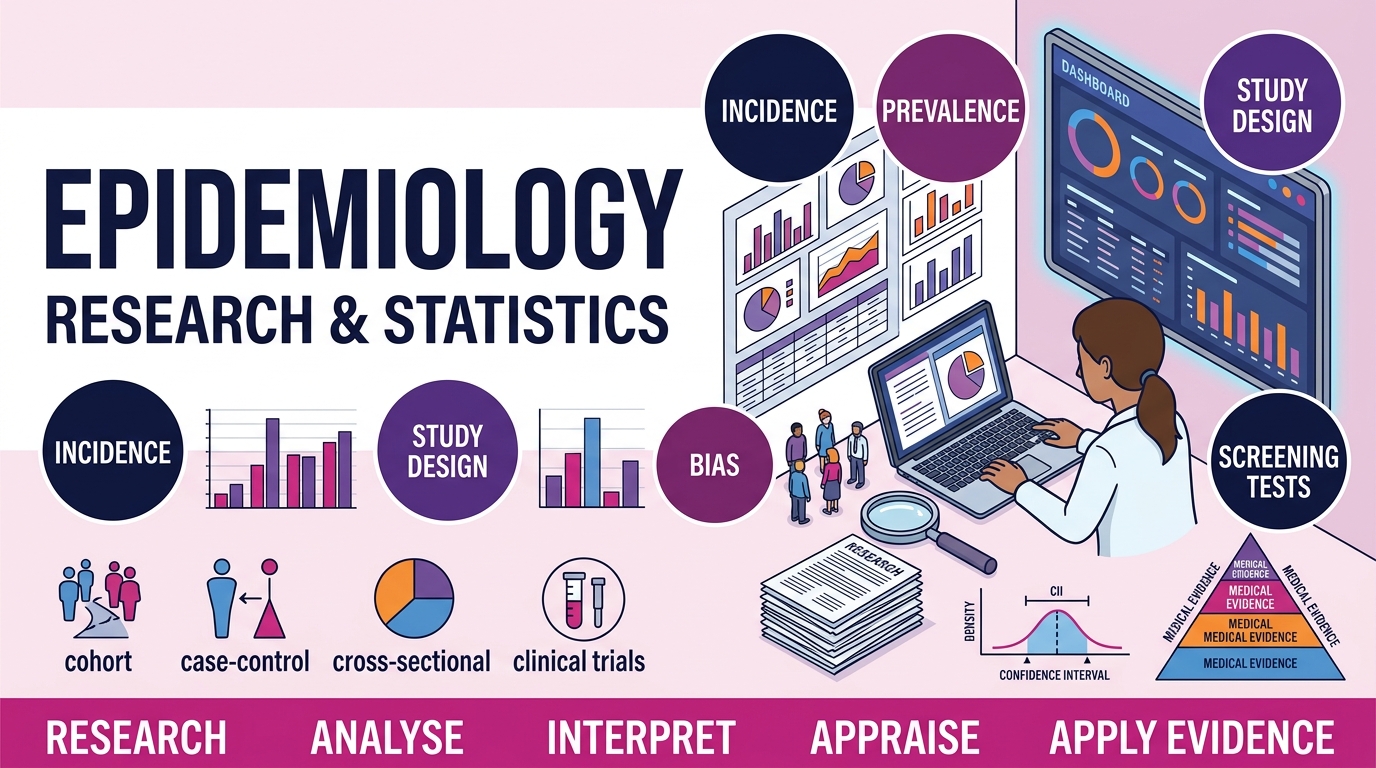 Course 09
Watch the introductory video to learn how the course makes research methodology, epidemiology, statistics, and critical appraisal practical and relevant to Occupational Medicine.
Evidence-based practice lies at the heart of modern Occupational Medicine. Occupational Health professionals are expected not only to understand scientific evidence but also to critically appraise research, interpret epidemiological data, evaluate workplace risks, and apply statistical findings to clinical and workplace decision making.
Whether assessing the health effects of workplace exposures, interpreting surveillance data, or reviewing published research, a sound understanding of research methods and statistics is essential for safe and effective Occupational Health practice.
This comprehensive 30 CPD hour course provides a practical and clinically relevant introduction to research methods, epidemiology, and statistics within Occupational Medicine.
Designed for Occupational Health physicians, nurses, trainees, and MFOM candidates, the programme develops the skills required to understand, interpret, and apply scientific evidence in workplace health settings.
Understand observation, research questions, hypothesis development, data collection, analysis, interpretation, and conclusion.
Learn how clear and focused research questions guide study design, population selection, outcomes, and analysis.
Understand null and alternative hypotheses and how statistical testing is used to evaluate research findings.
Explore consent, confidentiality, participant welfare, ethical approval, scientific integrity, and responsible research conduct.
Understand sampling, measurement, questionnaires, clinical information, exposure data, and outcome assessment.
Apply research findings to clinical decisions, workplace interventions, guidelines, and Occupational Health policy.
Epidemiology is the science of studying the distribution and determinants of health conditions within populations.
Within Occupational Medicine, epidemiological methods help identify patterns of work-related illness, investigate associations between workplace exposures and health outcomes, evaluate preventive measures, and support evidence-based workplace policy.
Describe disease patterns according to person, place, time, occupation, exposure, and workforce characteristics.
Compare groups and investigate possible associations between workplace exposures and health outcomes.
Evaluate interventions through controlled studies and assess their effects on health outcomes.
Apply population methods to workers, workplace exposures, occupational diseases, and preventive programmes.
Understand the occurrence of new cases within a population during a defined period.
Understand the proportion of a population affected by a condition at a particular time or over a period.
Evaluate the probability that an individual or group will develop a defined health outcome.
Interpret the frequency of health events in relation to population size and time at risk.
Compare the risk of an outcome between exposed and unexposed groups.
Understand the relationship between exposure and outcome, particularly within case-control research.
Learners will understand the purpose, structure, strengths, and limitations of the research designs commonly encountered in Occupational Medicine literature.
Examine exposure and health outcomes within a population at a defined point in time.
Compare people with a health outcome to those without it and examine previous exposure.
Follow exposed and unexposed groups to compare the occurrence of future health outcomes.
Evaluate interventions using random allocation and comparison between treatment or prevention groups.
Identify, assess, and synthesise relevant research using transparent and structured methods.
Statistically combine findings from multiple studies to estimate an overall effect.
Different study designs provide different levels and types of evidence. The most appropriate design depends on the research question, ethical considerations, feasibility, exposure, outcome, and population being studied.
Learners will develop a structured approach to evaluating research validity, relevance, methodology, analysis, results, limitations, and applicability to Occupational Health practice.
Identify the population, exposure or intervention, comparison group, and outcome being investigated.
Determine whether the selected design can answer the research question reliably.
Review participant selection, exposure measurement, outcome assessment, follow-up, and data quality.
Evaluate effect size, precision, statistical significance, bias, confounding, and consistency.
Consider relevance to the workforce, clinical setting, exposure, organisation, and intended intervention.
Understand how participant selection or loss to follow-up may influence study findings.
Explore measurement error, recall bias, misclassification, and inaccurate exposure or outcome assessment.
Identify additional factors that may distort the observed relationship between exposure and outcome.
Understand how the effect of an exposure may differ across subgroups or circumstances.
Distinguish statistical association from evidence that an exposure causes a health outcome.
Evaluate whether findings may be explained by random variation and how precisely effects have been estimated.
Understand chance, uncertainty, and the likelihood of observing particular results.
Interpret the estimated range within which the true population effect may lie.
Understand what p-values indicate and recognise common errors in their interpretation.
Evaluate whether findings are unlikely to be explained by chance under the null hypothesis.
Determine whether the size and practical importance of an effect are meaningful in real-world practice.
Understand false-positive and false-negative conclusions in statistical hypothesis testing.
Learners will develop a practical understanding of how statistical methods are used to examine relationships between variables and estimate the effects of workplace exposures.
The focus is placed on interpreting findings rather than complex mathematical calculation.
Understand the strength and direction of association between variables.
Interpret relationships between continuous variables and predicted outcomes.
Understand modelling where outcomes are categorical or binary.
Explore how statistical models account for confounding variables.
Understand the ability of a test to correctly identify people who have the condition.
Understand the ability of a test to correctly identify people who do not have the condition.
Interpret the probability that a person with a positive test result has the condition.
Interpret the probability that a person with a negative test result does not have the condition.
Understand how test results change the probability that a condition is present.
Evaluate test quality, prevalence, harms, benefits, follow-up, and suitability for workplace use.
Epidemiology and statistics are applied throughout modern Occupational Health practice.
A strong emphasis is placed on making complex statistical concepts understandable and clinically relevant.
Rather than focusing on mathematical calculations alone, learners will develop the practical skills required to interpret published evidence, critically appraise research papers, and make informed Occupational Health decisions based on high-quality evidence.
Evidence-based practice requires the integration of research evidence, clinical expertise, workplace information, employee circumstances, legal considerations, and organisational context.
Formulate a clear and answerable Occupational Health question.
Locate relevant and reliable research evidence.
Evaluate validity, relevance, precision, and limitations.
Use the evidence within the clinical and workplace context.
Review outcomes and improve future decisions.
Test research methodology, epidemiology, statistics, screening, critical appraisal, and practical application.
Practise answering questions under structured examination conditions and identify areas requiring revision.
Complete a comprehensive examination designed to support professional Occupational Medicine preparation.
Understand research methodology, scientific reasoning, hypothesis testing, and research ethics.
Interpret incidence, prevalence, risk, rates, relative risk, and odds ratios.
Critically evaluate common study designs, evidence hierarchies, bias, confounding, and causation.
Interpret confidence intervals, p-values, statistical significance, clinical significance, correlation, and regression.
Evaluate screening-test performance using sensitivity, specificity, predictive values, and likelihood ratios.
Apply research and statistical evidence confidently to Occupational Health practice and workplace decision making.
Learn with an academic author and experienced Occupational Health Physician practising in the United Kingdom.
Get full access to the video tutorial programme, more than 300 examination questions, timed assessments, a one-hour mock examination, and 30 CPD hours for £220.