Occupational History Taking
Take a focused and structured occupational history covering current duties, previous work, exposures, symptoms, function, and relevant workplace risks.
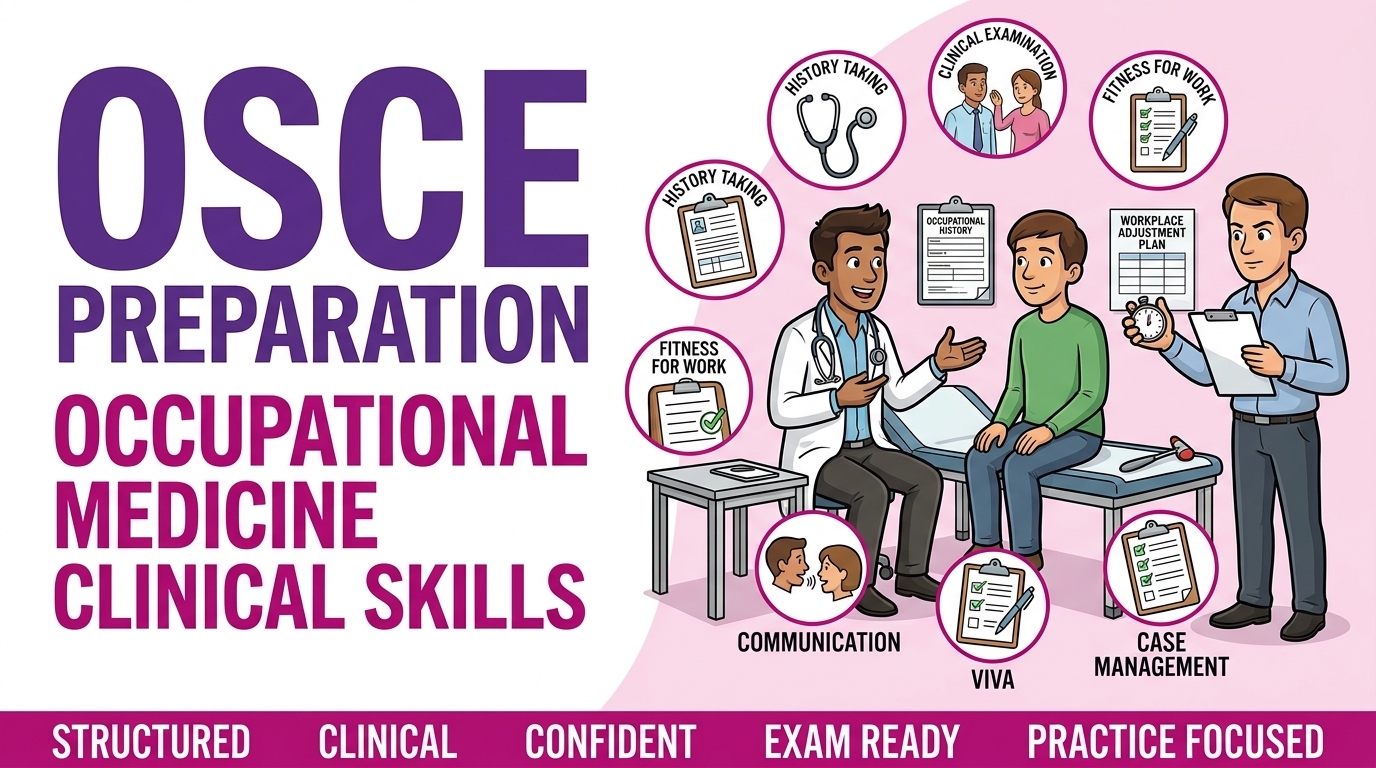
Build the Clinical, Communication and Examination Skills Required for Success
Develop a structured approach to Occupational Medicine long cases, short cases, viva stations, clinical examinations, fitness-for-work assessments, and professional communication.
 Course 10
Watch the course introduction to understand the teaching approach, OSCE frameworks, practical station walkthroughs, and examination techniques covered in this programme.
Success in Occupational Medicine examinations requires more than knowledge alone. Candidates must demonstrate the ability to communicate effectively, take focused occupational histories, perform structured clinical assessments, interpret findings accurately, and formulate sensible differential diagnoses.
Candidates must also assess fitness for work, recommend suitable workplace adjustments, communicate Occupational Health advice clearly, and demonstrate sound professional judgement under significant time pressure.
These practical and professional skills are at the heart of the Occupational Structured Clinical Examination and everyday Occupational Medicine practice.
This comprehensive 30 CPD hour course has been designed to help Occupational Health professionals develop the practical skills, confidence, and examination techniques required to excel in OSCE assessments and real-world consultations.
Take a focused and structured occupational history covering current duties, previous work, exposures, symptoms, function, and relevant workplace risks.
Conduct systematic clinical assessments that address the individual’s medical condition, symptoms, treatment, function, and workplace capability.
Communicate professionally, explain the Occupational Health role, obtain consent, show empathy, and manage complex consultations.
Generate appropriate differential diagnoses and explain how clinical findings support or challenge each possibility.
Relate medical findings to job demands, workplace hazards, functional capability, and safety requirements.
Provide clear, practical, proportionate, and defensible Occupational Health recommendations.
The programme provides detailed guidance on approaching Occupational Health long cases using clear, repeatable, and examiner-focused consultation frameworks.
Learners will develop a structured approach that ensures all important clinical, occupational, functional, ethical, and management domains are addressed while maintaining a patient-centred consultation.
Introduce yourself, confirm identity, explain the purpose and limits of the consultation, and establish informed consent.
Clarify the referral question, current symptoms, treatment, progress, concerns, and the individual’s understanding.
Explore duties, work pattern, demands, hazards, exposures, relationships, attendance, performance, and previous roles.
Assess physical, psychological, cognitive, social, and work-related functional capability.
Relate the condition and functional findings to workplace requirements, safety, reliability, and risk.
Provide a practical plan covering work status, restrictions, adjustments, rehabilitation, referral, and review.
A major component of the programme focuses on clinical examination skills for short case stations.
Participants will learn systematic examination techniques, recognition of important physical signs, interpretation of findings, sensible differential diagnosis, and discussion of occupational relevance.
Conduct a focused respiratory examination and relate findings to occupational respiratory disease and workplace exposure.
Recognise cardiovascular signs and discuss their relevance to exertional, driving, and safety-critical duties.
Assess motor, sensory, coordination, reflex, gait, and cognitive findings relevant to workplace function.
Assess movement, strength, pain, stability, function, and capability for physically demanding work.
Recognise common occupational skin findings and relate their distribution to possible workplace causes.
Identify clinically important signs and discuss their effect on work capability, safety, and further investigation.
Confirm the task, introduce yourself, obtain consent, position the patient, and maintain dignity.
Begin with general inspection before moving to focused examination of the relevant system.
Use an organised sequence and demonstrate safe, confident, and professional clinical technique.
Summarise positive and relevant negative findings clearly and accurately.
Offer a differential diagnosis, suggest further assessment, and explain the Occupational Health implications.
The course explores viva examination techniques and Occupational Medicine problem solving.
Learners will develop strategies for analysing clinical scenarios, identifying the important occupational issues, applying relevant standards, evaluating risks, and providing a clear and structured response.
Assess symptoms, function, workplace stressors, risk, adjustments, rehabilitation, and return to work.
Evaluate functional impact, workplace barriers, reasonable adjustments, and sustainable work participation.
Assess medical fitness, sudden incapacity, reliability, relevant standards, and public safety.
Explore workplace exposure, respiratory symptoms, clinical findings, surveillance, and fitness implications.
Assess exposure patterns, skin findings, control measures, surveillance, and work-related causation.
Recognise exposure pathways, clinical effects, biological monitoring, and workplace prevention.
Apply medical fitness guidance and assess conditions, treatments, symptoms, and driving-related risk.
Develop phased return plans, workplace adjustments, rehabilitation goals, and suitable review arrangements.
Establish your role, explain the consultation, and confirm understanding and consent.
Use open and focused questions efficiently while maintaining a natural and patient-centred consultation.
Acknowledge concerns, explore expectations, and respond sensitively to difficult or emotional situations.
Maintain independence, confidentiality, fairness, and clarity when balancing employee and employer interests.
Present advice using clear language and explain the reasoning behind restrictions, adjustments, or review.
Summarise the plan, confirm understanding, address questions, and explain the next steps.
The course places particular emphasis on examination technique, structured thinking, communication, time management, and maximising marks within each station.
Learners will understand what examiners are assessing, how marks are awarded, and how to demonstrate competence across clinical, occupational, ethical, communication, and management domains.
Identify exactly what the station requires before starting.
Follow a repeatable framework without sounding rehearsed.
Prioritise high-value tasks and monitor station progress.
Show clinical reasoning and explain the basis for decisions.
Connect clinical findings directly to work demands and risk.
Summarise conclusions, recommendations, and follow-up.
Observe structured approaches to common OSCE scenarios and clinical stations.
Develop speed, structure, confidence, and decision-making under examination conditions.
Consolidate clinical knowledge and Occupational Medicine decision-making skills.
Use structured templates for complex Occupational Health assessments and management planning.
Practise systematic clinical examinations and presentation of findings.
Complete a comprehensive mock assessment that reflects the style and challenge of professional examinations.
Conduct focused and structured Occupational Health consultations under time pressure.
Take comprehensive occupational histories and perform relevant functional assessments.
Perform systematic respiratory, cardiovascular, neurological, musculoskeletal, dermatological, and general examinations.
Interpret clinical findings, generate differential diagnoses, and discuss occupational relevance.
Make clear and defensible fitness-for-work decisions and workplace recommendations.
Demonstrate effective communication, professional judgement, time management, and examination technique.
Approach long cases, short cases, and viva stations with a consistent and confident structure.
Learn with an academic author and experienced Occupational Health Physician practising in the United Kingdom.
Get full access to the video tutorial programme, long and short case frameworks, timed exercises, more than 300 examination questions, a full mock examination, and 30 CPD hours for £220.