Human Error
Understand why errors occur and how individual, task, environmental, and organisational factors influence performance.

Safe, Ethical and High-Quality Occupational Health Practice
Develop the knowledge and professional confidence required to identify patient-safety risks, recognise safeguarding concerns, respond appropriately, and support safe Occupational Health services.
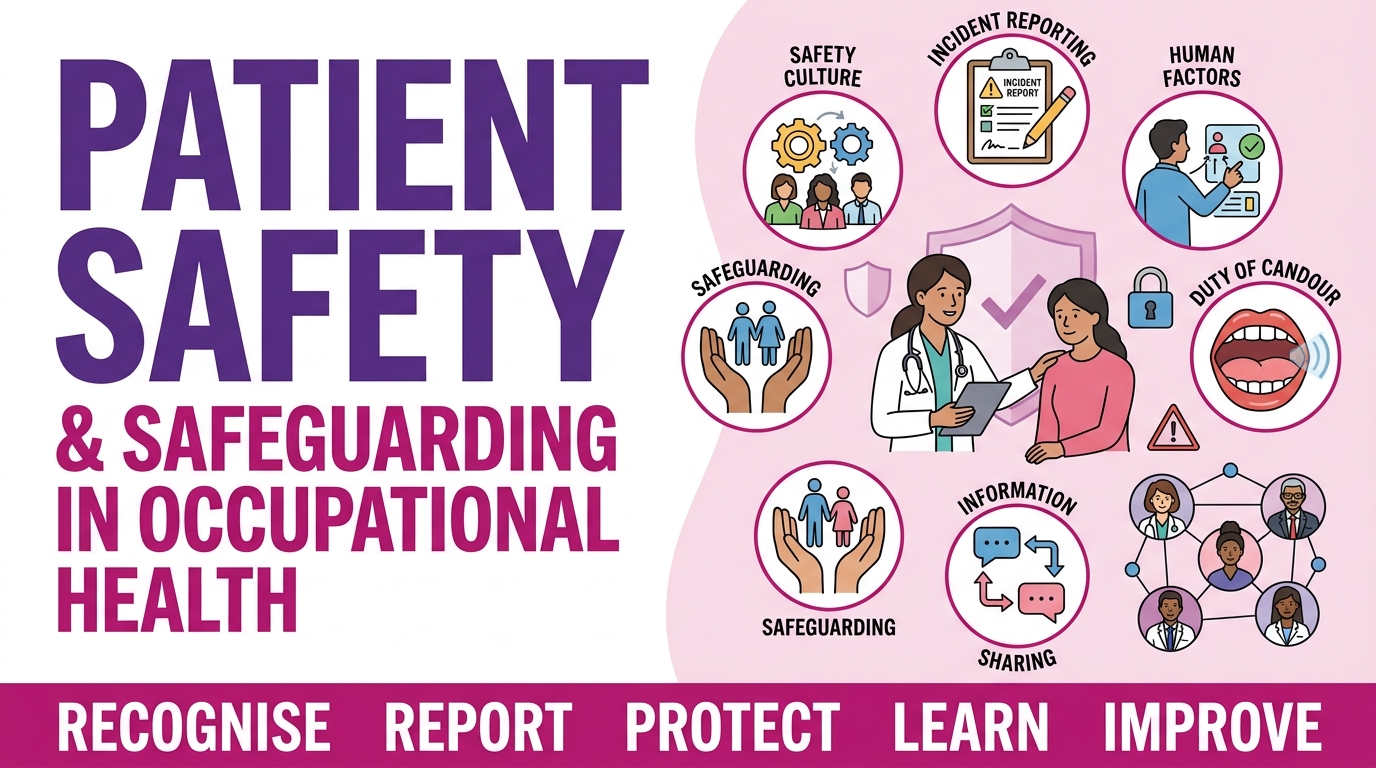 Course 08
Watch the introductory video to learn how the course approaches patient safety, safeguarding, incident learning, human factors, governance, and professional responsibility.
Patient safety and safeguarding are fundamental responsibilities of every healthcare professional. Within Occupational Medicine, clinicians frequently work at the interface between employee health, workplace risk, employer responsibilities, and public safety.
This unique position requires a clear understanding of how to identify risks, prevent harm, respond appropriately to concerns, and uphold professional standards while balancing ethical, legal, and organisational considerations.
This comprehensive 30 CPD hour course provides a practical and evidence-based introduction to patient safety and safeguarding within Occupational Medicine.
Designed for Occupational Health physicians, nurses, allied health professionals, and MFOM candidates, the programme explores the principles, systems, and professional responsibilities that underpin safe Occupational Health practice.
Understand why errors occur and how individual, task, environmental, and organisational factors influence performance.
Move beyond individual blame and examine how systems, processes, communication, and workplace design contribute to risk.
Explore leadership, openness, reporting, learning, accountability, teamwork, and psychological safety.
Recognise clinical, administrative, communication, information-governance, and workplace safety risks.
Use incidents, complaints, near misses, audits, and feedback to support continuous improvement.
Develop safer processes, effective controls, reliable communication, and appropriate escalation pathways.
The course examines the nature of human error and the factors that may contribute to adverse events in healthcare and Occupational Health services.
Learners will explore how workload, fatigue, interruptions, communication failures, unclear responsibilities, inadequate systems, poor workplace design, and organisational pressures may affect clinical performance.
Emphasis is placed on designing systems that make safe actions easier, reduce avoidable risk, and improve the reliability of Occupational Health services.
Learners will develop a practical understanding of how incidents and near misses should be reported, investigated, analysed, and used to reduce future risk.
Identify immediate risks, protect affected individuals, provide appropriate care, and escalate serious concerns.
Record relevant facts, preserve confidentiality, and use appropriate organisational reporting systems.
Examine individual, task, equipment, communication, environmental, team, and organisational factors.
Explore underlying system weaknesses rather than focusing only on the final action or individual involved.
Introduce corrective and preventive measures and evaluate whether they reduce the risk of recurrence.
Review important events in a structured manner to identify learning, improvement, and prevention opportunities.
Explore underlying system causes and the conditions that allowed an incident to occur.
Examine patient, task, staff, team, environment, communication, and organisational influences.
Learn from events that could have caused harm but were prevented before reaching the individual.
Understand openness, honest communication, apology, documentation, and professional responsibility.
Develop practical corrective actions that address underlying system weaknesses and support safer care.
The safeguarding section provides detailed coverage of safeguarding responsibilities across the lifespan.
Participants will learn how to recognise concerns, respond appropriately, document information, assess immediate risk, and use suitable referral and escalation pathways.
The programme explores professional responsibilities, multi-agency working, information sharing, confidentiality, consent, and the legal and ethical frameworks relevant to safeguarding practice.
Recognise indicators of abuse, neglect, exploitation, and circumstances requiring referral or urgent action.
Understand vulnerability, consent, capacity, confidentiality, exploitation, and appropriate professional support.
Identify physical, emotional, financial, organisational, and other forms of abuse or neglect.
Recognise possible indicators, respond sensitively, assess immediate safety, and provide appropriate signposting.
Understand workplace exploitation, coercion, trafficking, financial control, and other vulnerability concerns.
Recognise concerns relating to health, welfare, environment, capacity, vulnerability, and ability to protect oneself.
Occupational Health practitioners may encounter situations in which employee vulnerability or workplace circumstances create safeguarding concerns.
Respond calmly, gather relevant information, avoid making assumptions, and establish the immediate concern.
Determine whether urgent protection, emergency support, or immediate escalation may be required.
Record factual information, observations, decisions, advice, discussions, and actions accurately.
Follow local safeguarding procedures and consult suitable safeguarding professionals or services.
Balance confidentiality, consent, proportionality, legal duties, and the need to protect individuals from harm.
Safeguarding situations may require Occupational Health professionals to balance confidentiality with the need to protect an individual or others from serious harm.
Learners will explore consent, capacity, proportionality, minimum necessary disclosure, documentation, professional advice, and circumstances in which information sharing may be justified or required.
Particular emphasis is placed on communicating clearly with employees, maintaining trust where possible, following organisational procedures, and documenting the reasons for professional decisions.
Seek informed agreement wherever appropriate and possible.
Consider the individual’s ability to understand and decide.
Share only information relevant to managing the concern.
Record the reasoning, advice, decision, and information shared.
The programme examines the relationship between patient safety, professionalism, governance, clinical quality, risk management, and regulatory expectations.
Learners will gain a practical understanding of how governance systems support safer clinical decisions, consistent service quality, accountability, learning, and protection of employees and the wider public.
Use evidence, guidance, protocols, and professional standards.
Evaluate performance, compliance, outcomes, and service quality.
Identify, assess, control, monitor, and escalate clinical risk.
Turn incidents, feedback, and audit findings into safer systems.
Test knowledge and practical application across patient safety, safeguarding, governance, and risk management.
Practise under structured examination conditions and identify areas requiring further study.
Complete a comprehensive examination designed to support professional Occupational Medicine preparation.
Understand patient-safety principles, human factors, systems thinking, and safety culture.
Report, investigate, and learn from incidents, adverse events, and near misses.
Recognise safeguarding concerns involving children, young people, vulnerable adults, employees, and workplace settings.
Respond appropriately using risk assessment, documentation, referral, escalation, and multi-agency working.
Apply confidentiality, consent, information-sharing, governance, and professional standards confidently.
Learn with an academic author and experienced Occupational Health Physician practising in the United Kingdom.
Get full access to the video programme, more than 300 examination questions, timed assessments, a one-hour mock examination, and 30 CPD hours for £220.