Legal Framework
Understand the legal duties and workplace circumstances in which health surveillance may be required.
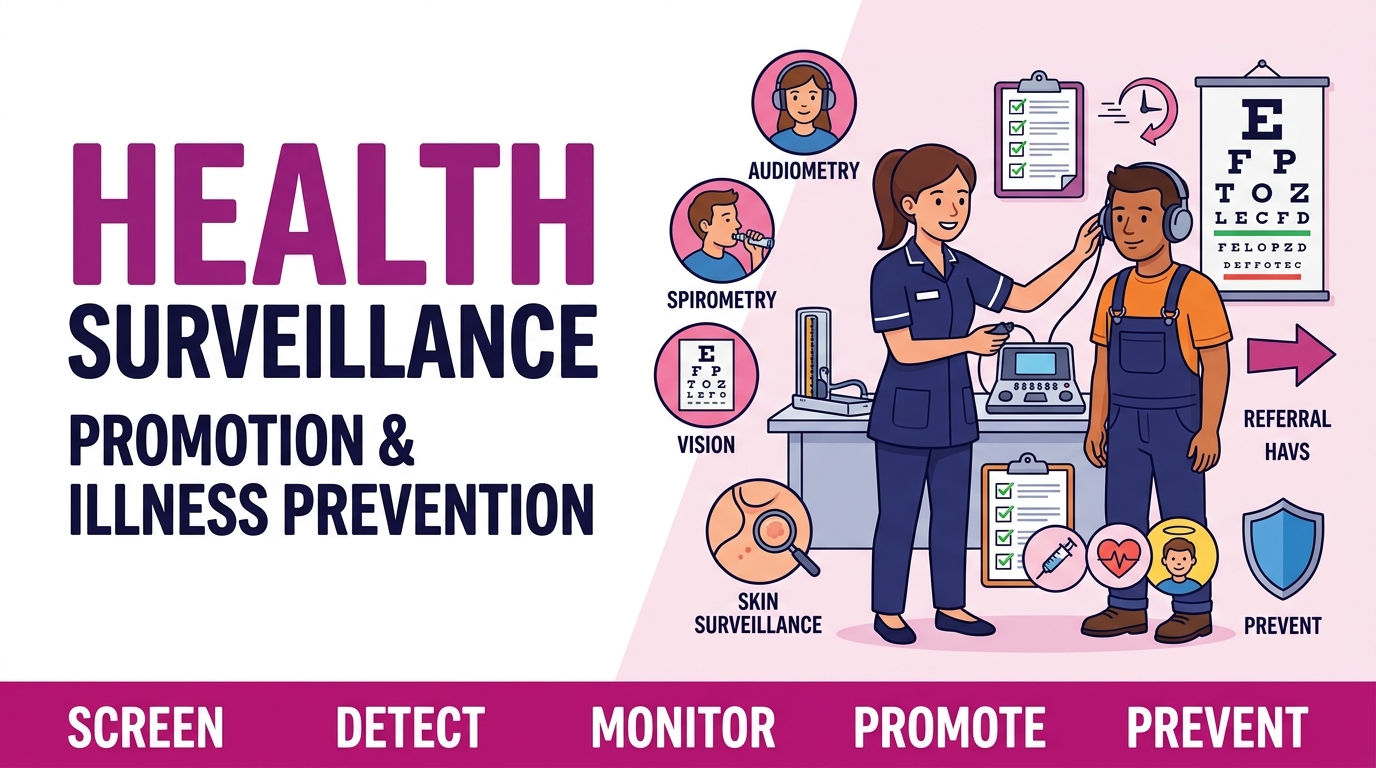
Identify Early Health Effects, Promote Wellbeing and Prevent Occupational Disease
Develop the knowledge and practical skills required to design, deliver, interpret, and improve workplace health surveillance and illness-prevention programmes.
 Course 07
Watch the introductory video to learn how this programme approaches health surveillance, workplace health promotion, early intervention, and occupational disease prevention.
Prevention remains one of the most important objectives of Occupational Health practice. While clinical assessment and fitness-for-work decision making are essential components of Occupational Medicine, protecting workers from developing occupational disease is equally important.
Effective health surveillance programmes, workplace health promotion initiatives, and early-intervention strategies help identify adverse health effects at an early stage, reduce the burden of occupational disease, and support a healthier and more productive workforce.
This comprehensive 30 CPD hour course provides a practical and evidence-based approach to health surveillance, health promotion, and illness prevention in the workplace.
Designed for Occupational Health physicians, nurses, technicians, and MFOM candidates, the course explores the principles, practice, and implementation of workplace health monitoring programmes across a wide range of industries and occupational exposures.
Understand the legal duties and workplace circumstances in which health surveillance may be required.
Use workplace risk information to determine whether a surveillance programme is appropriate and proportionate.
Select suitable methods, frequencies, clinical pathways, and quality controls for effective surveillance.
Understand health records, clinical records, retention, confidentiality, and appropriate information governance.
Identify significant findings, trends, deterioration, and possible early signs of occupational disease.
Determine when further assessment, workplace intervention, specialist referral, or exposure review is required.
Review hazardous exposures, job tasks, control measures, worker groups, and potential adverse health effects.
Choose appropriate questionnaires, clinical assessments, screening tests, measurements, and referral criteria.
Record initial health status and measurements before or early in relevant workplace exposure.
Repeat surveillance at suitable intervals and compare findings with previous results and expected standards.
Investigate abnormal results, refer when required, review exposure controls, and recommend workplace intervention.
Understand occupational visual standards, screening methods, test limitations, referral criteria, and workplace relevance.
Recognise occupational dermatitis, identify skin hazards, monitor symptoms, and support early workplace intervention.
Assess respiratory symptoms, exposure history, lung function, spirometry findings, and occupational respiratory risk.
Understand audiometry, hearing thresholds, significant changes, categorisation, quality assurance, and referral.
Identify neurological and vascular symptoms associated with hand-transmitted vibration and support staged assessment.
Link surveillance methods to specific workplace hazards, exposure profiles, legal duties, and control programmes.
Learners will develop a practical understanding of vision screening within Occupational Health and how visual capability may relate to specific job demands and safety requirements.
The programme covers test selection, visual acuity, colour vision, near and distance vision, limitations of screening methods, occupational visual standards, and appropriate referral pathways.
Occupational skin disease is common in workers exposed to wet work, irritants, sensitising substances, chemicals, gloves, oils, cleaning products, and biological agents.
This section explains how to identify early skin symptoms, conduct structured surveillance, recognise occupational dermatoses, document findings, advise on skin care, and recommend suitable workplace intervention.
Recognise common patterns associated with repeated contact with water, detergents, chemicals, and workplace substances.
Understand sensitisation, relevant exposures, clinical assessment, and the role of specialist investigation.
Support effective exposure controls, glove selection, skin care, worker education, and early symptom reporting.
Identify findings that require further Occupational Health, dermatology, or workplace hygiene investigation.
Learners will gain practical knowledge of respiratory health surveillance for workers exposed to respiratory sensitisers, dusts, fumes, gases, vapours, and other inhaled hazards.
The course explains symptom questionnaires, exposure history, spirometry methodology, quality standards, interpretation, limitations, serial comparison, and appropriate clinical follow-up.
Determine when respiratory surveillance is required based on exposure and potential health effects.
Understand worker preparation, technique, acceptability, repeatability, calibration, and quality assurance.
Identify patterns, significant change, technical limitations, and findings requiring further assessment.
Use surveillance findings to support exposure review, referral, control improvement, and worker protection.
This section provides a practical framework for delivering hearing surveillance to workers exposed to occupational noise and other potential risks to hearing.
Learners will explore baseline testing, periodic audiometry, hearing thresholds, result categorisation, significant change, test reliability, referral pathways, hearing protection, and workplace noise-control measures.
The course explains the principles of Hand-Arm Vibration Syndrome surveillance for workers using vibrating tools, machinery, and equipment.
Learners will study symptom recognition, vascular and neurological features, staged surveillance, clinical assessment, exposure review, functional impact, referral, and appropriate workplace recommendations.
Review tools, vibration exposure, duration, work patterns, control measures, and previous symptoms.
Recognise episodic finger blanching, cold sensitivity, and symptoms associated with vibration exposure.
Assess numbness, tingling, sensory change, reduced dexterity, and functional limitation.
Recommend exposure reduction, control review, referral, restrictions, or further clinical assessment.
In addition to health surveillance, the course explores wider workplace prevention strategies and the role of Occupational Health services in supporting long-term workforce wellbeing.
Participants will learn how workplace programmes can support behavioural change, reduce health risks, improve resilience, and help prevent occupational and non-occupational illness.
Support evidence-based workplace smoking reduction programmes.
Promote risk awareness, screening, activity, and prevention.
Understand workplace immunisation and exposure prevention.
Promote movement, ergonomics, early reporting, and rehabilitation.
Support psychologically healthy workplaces and early intervention.
Improve health literacy, coping, participation, and long-term wellbeing.
A strong emphasis is placed on translating surveillance findings into meaningful workplace action.
Learners will develop the skills required to identify early signs of occupational disease, recommend appropriate workplace interventions, support exposure-control measures, and work collaboratively with employers to reduce health risks.
Surveillance should not operate as an isolated screening exercise. Its findings should contribute to risk assessment, exposure control, worker education, clinical referral, programme evaluation, and prevention.
Recognise significant symptoms, measurements, and trends.
Arrange review, referral, advice, or temporary intervention.
Assess hazards, controls, work processes, and affected groups.
Strengthen controls, education, surveillance, and follow-up.
Test theoretical knowledge and practical application across the health surveillance syllabus.
Practise answering questions under structured and timed examination conditions.
Complete a comprehensive mock assessment designed to support professional examination preparation.
Understand the principles, objectives, and legal framework governing workplace health surveillance.
Design and deliver suitable surveillance programmes based on workplace risk and occupational exposure.
Interpret vision, skin, respiratory, hearing, and HAVS surveillance findings appropriately.
Recognise early signs of occupational disease and recommend appropriate referral and workplace intervention.
Develop workplace health-promotion strategies that support wellbeing, resilience, and illness prevention.
Learn with an academic author and experienced Occupational Health Physician practising in the United Kingdom.
Get full access to the video tutorial programme, more than 300 examination questions, timed assessments, a one-hour mock examination, and 30 CPD hours for £220.