Toxicokinetics
Understand how hazardous substances are absorbed, distributed, metabolised, and eliminated by the body.

Recognise, Assess and Manage Toxic Hazards in the Workplace
Develop a practical and clinically focused understanding of occupational toxicants, exposure pathways, toxicological mechanisms, clinical effects, biological monitoring, and workplace prevention.
 Course 06
Watch the course introduction to learn how toxicological science is applied to real-world Occupational Health assessment, prevention, surveillance, and workforce protection.
Every day, millions of workers are exposed to chemicals, metals, gases, fumes, solvents, dusts, and environmental contaminants.
While many exposures are harmless when adequately controlled, others may contribute to acute poisoning, chronic disease, cancer, neurological injury, respiratory illness, reproductive harm, and long-term disability.
Understanding how toxic substances interact with the human body is therefore a fundamental skill for every Occupational Health professional.
This comprehensive 30 CPD hour course provides a practical and clinically focused exploration of toxicology within Occupational Medicine. It bridges the gap between toxicological science and real-world Occupational Health practice.
Understand how hazardous substances are absorbed, distributed, metabolised, and eliminated by the body.
Explore how toxic agents interact with tissues, organs, receptors, and biological systems to produce harmful effects.
Understand how exposure level, duration, frequency, and individual susceptibility influence toxicity.
Learn how chemicals are classified according to their physical properties, biological effects, and health hazards.
Explore the mechanisms, classifications, latency periods, and Occupational Health implications of carcinogenic exposures.
Combine hazard information, exposure evidence, clinical data, and occupational context to evaluate health risk.
Exposure to gases, vapours, fumes, fibres, aerosols, and respirable workplace dusts.
Uptake of hazardous substances through direct skin contact, contaminated clothing, and repeated exposure.
Exposure through contaminated hands, food, drink, smoking, poor hygiene, or accidental transfer.
Exposure through sharps, high-pressure equipment, damaged skin, punctures, or contaminated injuries.
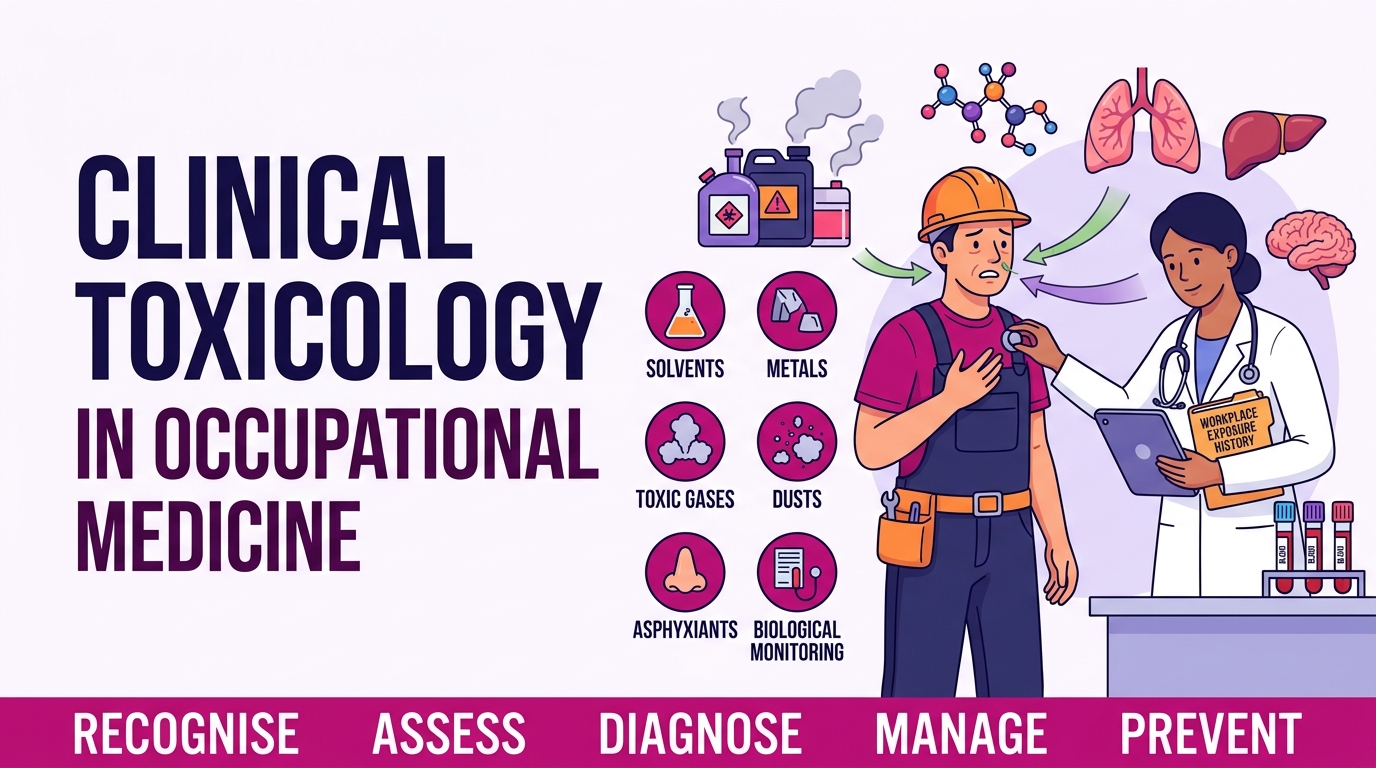
The course explores the toxicological properties, mechanisms, presentations, assessment, management, and prevention associated with major workplace toxicants.
Understand acute effects, long-term neurological risks, exposure routes, target organs, and workplace control.
Explore the Occupational Health effects of lead, mercury, cadmium, arsenic, manganese, and other metals.
Assess respiratory irritation, delayed effects, chemical lung injury, and emergency exposure scenarios.
Understand oxygen displacement, confined-space risks, workplace monitoring, and prevention.
Examine toxic agents that interfere with oxygen transport, cellular respiration, or tissue oxygen use.
Explore occupational and community health risks from environmental contamination and industrial pollutants.
Recognise neurological and cognitive effects associated with repeated exposure to organic solvents.
Understand common exposure settings, presentation, assessment, prevention, and workplace control.
Explore toxic exposures contributing to respiratory irritation, inflammation, and chronic pulmonary disease.
Understand carcinogenic agents, disease patterns, latency, exposure history, and prevention.
Assess toxic respiratory exposure and understand the occupational implications of chemical lung injury.
Recognise workplace toxicants associated with sensory, motor, and mixed peripheral nerve disorders.
Understand relevant chemical exposures, clinical recognition, exposure investigation, and prevention.
Explore neurological disease patterns associated with occupational exposure to toxic metals.
Particular emphasis is placed on recognising occupational disease patterns and understanding latency periods, target organ toxicity, exposure pathways, and biological monitoring.
Learners will explore how biological monitoring is used to assess internal exposure, how results should be interpreted, and how monitoring data can support workplace risk evaluation.
The course also explains the relationship between environmental monitoring, biological monitoring, clinical assessment, exposure history, and occupational disease prevention.
Identify substances, routes, duration, frequency, and controls.
Interpret workplace air, surface, and process measurements.
Understand the use of blood, urine, and other biological indicators.
Relate symptoms and examination findings to possible toxic exposure.
Determine the substance, chemical class, physical form, workplace process, and likely toxicological properties.
Consider route, concentration, frequency, duration, controls, protective equipment, and individual factors.
Review symptoms, target-organ patterns, examination findings, investigations, and possible latency.
Combine environmental data, biological monitoring, clinical findings, and toxicological reference information.
Support medical management, exposure control, surveillance, workplace protection, and prevention of further harm.
The course provides a practical framework for interpreting toxicological information in clinical practice and understanding how chemical structure may influence toxicity.
Learners will explore how exposure assessment contributes to risk evaluation and how Occupational Health professionals can support prevention, surveillance, worker education, and workforce protection.
Emphasis is placed on effective collaboration with employers, occupational hygienists, safety professionals, laboratories, healthcare providers, and exposed workers.
Consolidate knowledge and test the practical application of occupational toxicology principles.
Assess progress across major syllabus areas under timed examination-style conditions.
Complete a comprehensive mock examination designed to reflect professional Occupational Medicine assessments.
Understand toxicokinetics, toxicodynamics, dose-response relationships, chemical classification, and carcinogenesis.
Recognise the major categories of occupational toxicants and their target-organ effects.
Assess exposure pathways, latency periods, occupational disease patterns, and clinical presentations.
Interpret exposure information, biological monitoring results, and toxicological evidence.
Provide practical Occupational Health advice that supports prevention, surveillance, and workforce protection.
Learn with an academic author and experienced Occupational Health Physician practising in the United Kingdom.
Get full access to 30 video tutorials, more than 300 examination questions, timed assessments, a full mock examination, and 30 CPD hours for £220.