Functional Assessment
Assess how medical conditions affect function, capability, reliability, attendance, and workplace performance.
The Practical Heart of Occupational Medicine
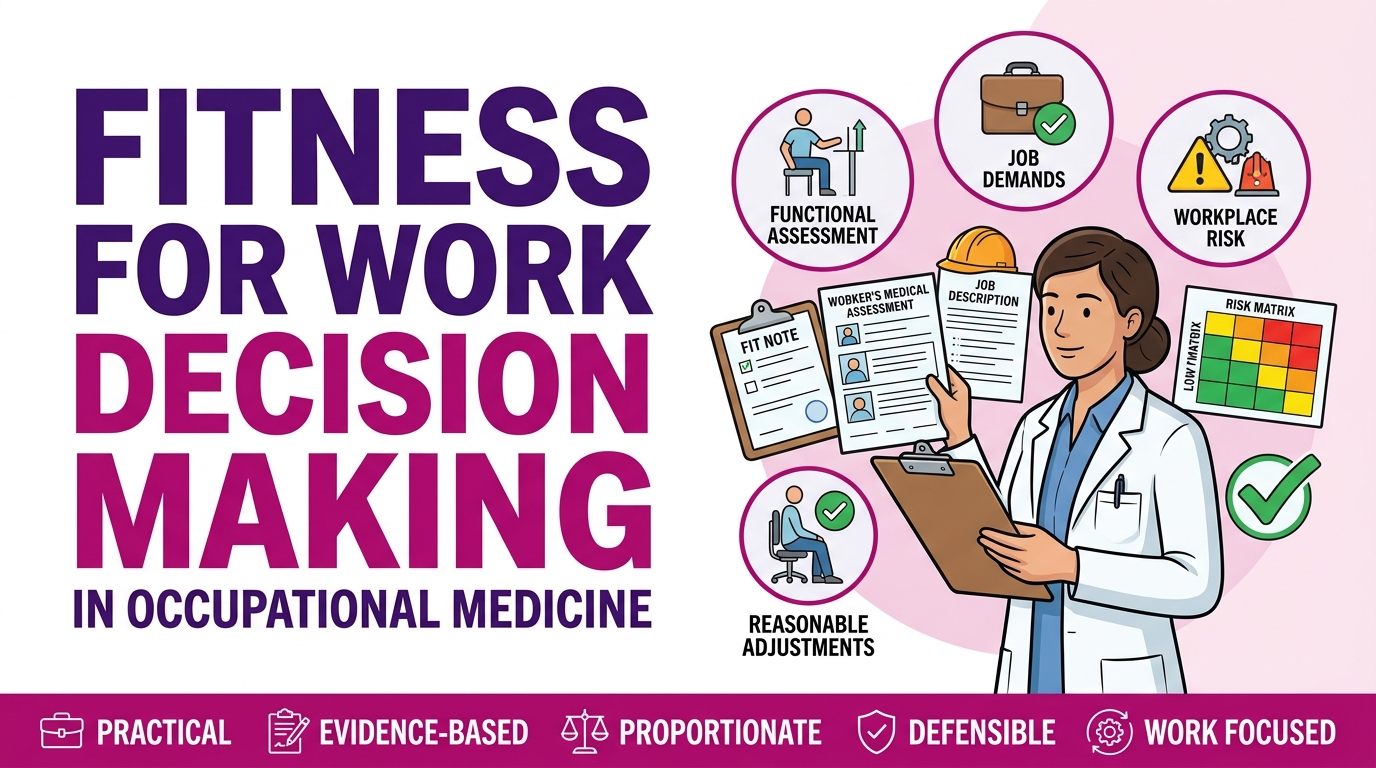
Develop the clinical reasoning, workplace risk assessment, and professional judgement required to make safe, proportionate, and defensible fitness-for-work decisions.
 Course 02
Watch the introductory video to understand the course structure, teaching approach, and practical fitness-for-work framework.
Fitness-for-work assessment lies at the heart of Occupational Medicine. Every day, Occupational Health professionals are required to make complex decisions that balance worker health, workplace risk, operational requirements, legal obligations, and public safety.
These decisions can have significant consequences for individuals, employers, and organisations, making a structured and evidence-based approach essential.
This comprehensive course has been designed to develop the clinical reasoning, risk assessment skills, and professional judgement required to make safe, defensible, and practical fitness-for-work decisions.
Delivered through 19 in-depth video tutorials, 350 examination-style multiple choice questions, and 30 hours of CPD-accredited learning, the programme provides a systematic framework for assessing fitness for work across a wide range of occupational scenarios.
Assess how medical conditions affect function, capability, reliability, attendance, and workplace performance.
Understand the physical, psychological, cognitive, and safety-related demands of different occupational roles.
Identify and evaluate risks to the employee, colleagues, employers, and members of the public.
Apply outcomes including fit for work, fit with adjustments, temporary restrictions, redeployment, and permanent unfitness.
Produce practical and proportionate recommendations that support safe and sustainable employment.
Justify recommendations and communicate clear conclusions to workers, managers, employers, and other stakeholders.
The course examines the full spectrum of possible fitness-for-work recommendations.
Assess functional limitations, physical job demands, rehabilitation needs, and workplace adjustments.
Evaluate psychological function, workplace stressors, attendance, safety, and sustainable return to work.
Consider cognition, mobility, reliability, medication, recurrence risk, and safety-sensitive duties.
Assess physical capacity, risk of sudden incapacity, treatment effects, and occupational demands.
Evaluate symptoms, exposure risks, respiratory function, protective equipment, and work capacity.
Understand how medication effects may influence alertness, cognition, coordination, and workplace safety.
The programme covers sickness absence management, return-to-work planning, rehabilitation strategies, workplace adjustments, disability considerations, and effective risk communication.
Learners will develop the ability to move beyond diagnosis alone and focus on how health conditions affect an individual’s function, capability, reliability, and workplace safety.
Particular emphasis is placed on producing recommendations that are practical, proportionate, and capable of withstanding professional, legal, and regulatory scrutiny.
A major focus of the programme is the development of higher-level Occupational Medicine judgement. Through case-based learning and examination-style questions, participants learn how to analyse uncertainty, balance competing risks, justify recommendations, and communicate conclusions clearly.
By the end of the course, learners will have a structured framework for approaching fitness-for-work assessments and the confidence to make decisions that are clinically sound, ethically robust, legally defensible, and practically useful.
Use a structured and evidence-based framework when assessing fitness for work.
Analyse job demands, functional capacity, workplace risk, and safety requirements.
Recommend suitable workplace adjustments, restrictions, rehabilitation, or redeployment.
Balance worker health, organisational requirements, legal obligations, and public safety.
Deliver confident, consistent, proportionate, and defensible Occupational Health advice.
Get full access to 19 video tutorials, 350 examination-style questions, and 30 CPD-accredited learning hours for £220.